Balancing Early Contractor Involvement with Commercial Certainty

In today’s construction industry, clients face increasing pressure to deliver projects faster while managing rising costs, evolving designs, and increasingly complex stakeholder requirements. Traditional procurement routes, where design is completed before contractors are invited to tender, can struggle to keep pace with these demands. As a result, two-stage tendering has become an increasingly attractive procurement strategy across major infrastructure, commercial, and industrial developments.
By bringing the contractor into the project before the design is fully complete, two-stage tendering promises earlier collaboration, improved buildability, and greater programme certainty. However, it also introduces commercial and contractual risks that can undermine these very benefits if not managed carefully.
The question is no longer whether two-stage tendering is a good procurement route -but whether it is the right procurement route for a particular project.
What Is Two-Stage Tendering?
Unlike traditional single-stage procurement, where contractors compete on a developed design and submit a bid, two-stage tendering separates contractor selection from the final contract price.
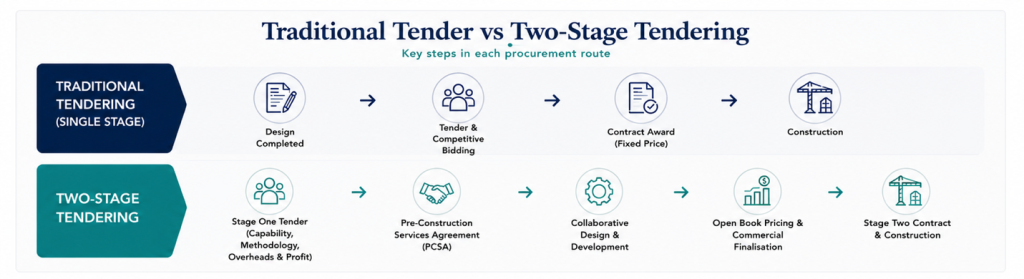
During Stage One, contractors compete primarily on their capability, experience, methodology, overheads, profit, and preliminary costs rather than on a fully developed construction price. The successful contractor is then appointed under a Pre-Construction Services Agreement (PCSA) or a similar arrangement.
During this pre-construction period, the contractor works collaboratively with the client and design team to:
- develop the design;
- review buildability and sequencing;
- engage with specialist subcontractors;
- identify procurement risks;
- prepare the final construction price.
Once sufficient design development has been achieved and commercial terms are agreed, the parties proceed to Stage Two, where the main construction contract is executed.
This approach reflects a growing recognition that contractor expertise can add significant value before construction even begins.
The Advantages of Early Contractor Involvement
When applied appropriately, two-stage tendering can produce substantial project benefits.
Perhaps the most significant advantage is improved buildability. Contractors contribute practical construction knowledge while design decisions are still being made, helping eliminate inefficient details, improve construction sequencing, and reduce later redesign.
The procurement route also supports programme acceleration. Rather than waiting for every design element to be completed, procurement activities, subcontractor engagement, and long-lead material packages can begin much earlier.
Another important benefit is better cost visibility. Although the final contract sum may not initially be fixed, open-book pricing allows clients to understand how costs are developing as the design matures. This often leads to more informed commercial decisions than relying solely on competitive tender prices prepared against incomplete information.
Early collaboration also encourages stronger relationships between the client, consultants, and contractor. Instead of becoming involved only after contract award, the contractor becomes part of the project team during the critical planning phase, often leading to more realistic programmes and better risk identification.
Where the Risks Begin
Despite these advantages, two-stage tendering is not without its challenges.
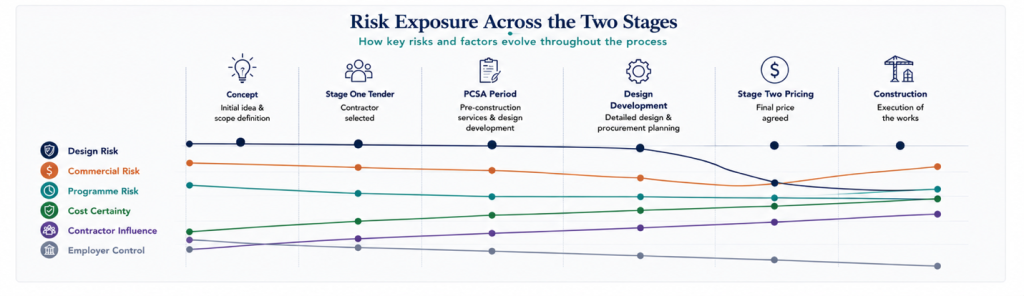
The most common misconception is that appointing a contractor early automatically reduces project risk. In reality, some risks simply move from construction into procurement.
One of the greatest concerns is the loss of competitive tension.
Once a contractor has invested several months in developing the design and preparing the project, the employer may have limited appetite to restart procurement if commercial negotiations fail. The contractor, recognising this position, may possess considerably greater negotiating leverage than during Stage One.
Similarly, if the scope of work continues to evolve without clear governance, the project can experience scope creep, making it increasingly difficult to establish a reliable contract price.
Another frequent problem arises from poorly drafted Pre-Construction Services Agreements. PCSAs often focus on collaboration while giving insufficient attention to measurable deliverables, design responsibilities, pricing methodologies, programme obligations, intellectual property, or termination rights.
Without clearly defined expectations, disagreements can emerge before the main construction contract is even signed.
Open-book pricing, although valuable, also requires transparency and robust commercial management. If subcontract procurement lacks competitive discipline or pricing assumptions are inadequately documented, disputes over cost certainty may quickly develop.
As Roger Knowles observes, the success of two-stage tendering depends less on the procurement route itself than on how effectively the process is managed throughout both stages.
When Two-Stage Tendering Makes Sense
Two-stage tendering is not a universal solution.
It is generally most effective where projects involve:
- complex construction methodologies;
- significant design development during procurement;
- demanding programme constraints;
- specialist engineering systems;
- long-lead procurement packages;
- high levels of coordination between multiple disciplines.
Examples include data centres, airports, hospitals, advanced manufacturing facilities, and major infrastructure projects, and high-end building where contractor expertise can materially improve delivery outcomes.
Conversely, projects with well-developed designs, clearly defined scope, and straightforward construction methods may gain little benefit from early contractor involvement. In these cases, the additional procurement complexity may outweigh the potential advantages.
Selecting the appropriate procurement strategy should therefore be based on project characteristics rather than market trends or client preference alone.
Harmony’s Perspective
In our experience, successful two-stage tendering is rarely determined by procurement strategy alone. It is determined by governance.
Clients often focus on selecting the right contractor but devote less attention to defining how Stage One will be managed. Yet this period frequently determines whether the project enters construction with confidence -or uncertainty.
A well-managed two-stage procurement should establish clear objectives from the outset:
- defined Stage One deliverables;
- transparent pricing methodology;
- structured design development milestones;
- robust commercial reporting;
- agreed risk allocation;
- measurable criteria for progressing into Stage Two.
Equally important is maintaining commercial discipline throughout the process. Early collaboration should never replace independent cost verification, programme scrutiny, or contractual clarity.
Construction projects increasingly demand flexibility, but flexibility should never come at the expense of governance.
Key Takeaways
Before selecting a two-stage procurement strategy, project teams should consider several fundamental questions:
- Is early contractor involvement genuinely required?
- Has the scope been sufficiently defined to support collaborative development?
- Does the PCSA clearly establish responsibilities, deliverables, and exit provisions?
- Is there a transparent methodology for developing the final contract price?
- Are governance, reporting, and commercial controls in place throughout Stage One?
- Does the project team possess the capability to actively manage collaborative procurement?
Answering these questions early can significantly improve the likelihood of achieving the intended benefits of two-stage tendering.
Conclusion
Two-stage tendering represents an evolution in procurement rather than a replacement for traditional competitive tendering.
When implemented appropriately, it can improve collaboration, enhance buildability, reduce programme risk, and enable better-informed commercial decisions. However, these benefits are realised only when supported by disciplined governance, clearly defined contractual arrangements, and proactive commercial management.
Ultimately, two-stage tendering should not be viewed as a shortcut to faster procurement. It is a structured procurement strategy that demands careful planning, transparent collaboration, and experienced project leadership.
For organisations delivering increasingly complex construction projects, the question is not simply whether to adopt two-stage tendering -but how to implement it in a way that delivers certainty rather than creating new sources of risk.
References
- Knowles, R. (2012). 200 Contractual Problems and Their Solutions (3rd ed.). Wiley-Blackwell.
https://www.wiley.com/en-us/Trade%2B%26%2BTechnology%2BLaw-c-LA41 - Royal Institution of Chartered Surveyors (RICS). Tendering Strategies, 1st Edition: RICS Guidance Note.
https://www.rics.org/profession-standards/rics-standards-and-guidance/sector-standards/construction-standards/black-book/tendering-strategies - Chartered Institute of Building (CIOB). Code of Practice for Project Management for the Built Environment (6th ed.).
https://www.ciob.org/news/new-edition-of-the-code-of-practice-for-project-management-for-construction-professionals-out-now - Joint Contracts Tribunal (JCT). Pre-Construction Services Agreement (General Contractor) (PCSA 2024).
https://www.jctltd.co.uk/product/pre-construction-services-agreement-general-contractor - FIDIC. FIDIC Procurement Procedures Guide (1st ed., 2011).
https://fidic.org/books/fidic-procurement-procedures-guide-1st-ed-2011 - UK Government, Procurement Advisory Group. Guidance on Collaborative Procurement for Design and Construction to Support Building Safety.
https://www.gov.uk/government/publications/collaborative-procurement-guidance-for-design-and-construction-to-support-building-safety