
Strategies, Risks, and Practical Insights for Modern Construction Projects

In major construction projects, traditional lump sum contracts are often seen as the safest route to price certainty. On paper, the promise is straightforward: a clearly defined scope, an agreed price, and a structured allocation of risk.
Once construction starts, however, design development, late decisions, and unforeseen conditions quickly test how fixed that price really is. At this point, change management stops being a back-office process and becomes a strategic project function.
This article explores how traditional lump sum contracts can be used to maximise cost certainty while retaining enough flexibility to manage change without damaging relationships or project outcomes.
The foundation: what is a traditional lump sum contract?
Under the traditional design-bid-build procurement route, the client’s design team completes the design and prepares full tender documentation before inviting contractors to price the works as a single lump sum.
This sequential structure gives the client strong control over design and quality, while transferring most time and cost overrun risk within the defined scope to the contractor.
The model works best where the project brief is clear, technical risk is manageable, and the client values pre-contract price certainty more than maximum flexibility during delivery.
Because all bidders price the same information, proposals can be compared on a true like-for-like basis, allowing contractors to plan resources, pricing, and margin around a known risk profile.
Table 1 – How lump sum compares to other routes
| Criterion | Traditional Lump Sum | Design & Build | Management Contracting | Cost Reimbursement |
| Cost certainty at contract award | High | High (depends on employer’s requirements) | Medium | Low |
| Client design control | High | Medium | High | High |
| Risk carried by contractor | High (within scope) | High | Low to medium | Low |
| Speed to completion | Medium | High | High | Medium |
| Flexibility for change | Low | Low to medium | High | High |
Where cost certainty is real and where it is not
The core attraction of lump sum contracts lies in the commitment to deliver a defined scope for an agreed price, with deviations managed through formal variation procedures. This makes them particularly attractive for projects requiring early budget approval or external financing.
In practice, however, contractors price uncertainty into their tenders. Productivity risks, coordination challenges, market volatility, and potential changes are reflected in contingencies built into the lump sum. As a result, cost certainty is often achieved at a premium.
Where contracts push excessive or unmanageable risk onto contractors, such as incomplete design, unknown ground conditions, or price escalation, market response can be distorted. Prices increase, competition reduces, or experienced contractors choose not to bid.
Why change is inevitable in a fixed-price environment
Even with well-developed designs, change is rarely eliminated entirely. Late user requirements, clashes with existing assets, regulatory updates, and supply chain disruptions frequently arise during construction.
On complex projects, third-party interfaces with utilities, neighbours, and public authorities introduce risks that cannot realistically be resolved fully at tender stage. These interfaces often drive changes that materially affect both time and cost.
While clients may interpret lump sum as a fixed final cost, contractors focus on their contractual entitlements when the agreed scope is altered. Without a shared understanding of how change will be managed, variations escalate into disputes rather than structured commercial adjustments.
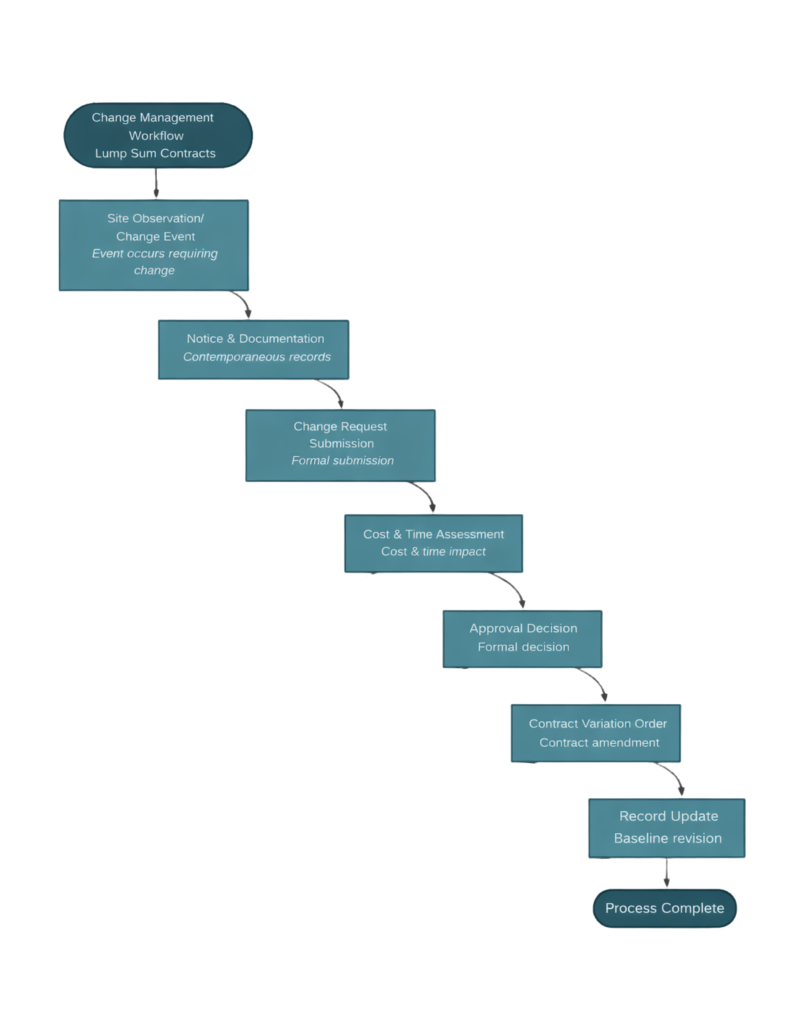
Infographic – Lump sum change management workflow
A typical change management process under a lump sum contract includes:
- Identification of a change event on site
- Early notice and contemporaneous records
- Formal change request submission
- Assessment of time and cost impact
- Employer or engineer determination
- Issue of a variation instruction
- Update of contract sum and programme
Presented visually as a seven-step workflow, this process reinforces procedural discipline, transparency, and accountability.
Building a robust change management framework
Effective change management in lump sum contracts depends on clear contractual mechanisms and a workflow that site teams can apply consistently.
Key elements include early notification, structured change request formats, timely assessment of time and cost impacts, and prompt updates to the contract sum and programme once decisions are made.
Contemporaneous records such as site instructions, photographs, daily reports, updated schedules, and marked-up drawings form the backbone of fair valuation and dispute avoidance. Digital tools for document control and cost forecasting further improve visibility, allowing leadership teams to track approved and pending changes against contingency in real time.
Practical actions for project leaders
- Freeze critical scope elements before tender wherever possible
- Establish a clear, written change protocol aligned with the contract
- Train both client and contractor teams on notice and variation procedures
- Hold regular commercial risk reviews focused on emerging issues
- Use simple dashboards to track the impact of changes on cost and programme
These measures do not eliminate change, but they ensure it is managed deliberately and predictably.
A balanced way forward
Traditional lump sum contracts are not suitable for every project. Used in the right context, and supported by realistic risk allocation and disciplined change management, they remain a powerful procurement tool.
By investing in stronger front-end definition, aligning expectations around risk, and treating change as a managed commercial process, project teams can turn the fine line between cost certainty and change into a controlled, data-driven pathway that protects budgets, relationships, and long-term asset value.
Key References
- RICS – Developing a Construction Procurement Strategy
https://www.rics.org/content/dam/ricsglobal/documents/standards/Appropriate-contract-selection-2nd-edition.pdf - FIDIC – Management of Change within Construction Contracts
https://fidic.org/sites/default/files/6%20Management%20of%20Change%20within%20construction%20contracts.pdf - JCT – Traditional / Conventional Procurement Overview
https://corporate.jctltd.co.uk/products/procurement/traditionalconventional/ - Procore – Lump Sum Contracts in Construction
https://www.procore.com/library/lump-sum-contracts - Construction Claims Class – Managing Delays and Change in Lump Sum Contracts
https://www.constructionclaimsclass.com/how-to-manage-delays-and-change-in-lump-sum-contracts/ - UNCITRAL – Legal Guide on Construction Contracts
https://uncitral.un.org/sites/uncitral.un.org/files/media-documents/uncitral/en/legal_guide_e.pdf