
Managing the Process, Not the Works: Pros, Cons, and Key Success Factors

In the landscape of modern project delivery, the shift from traditional general contracting to professional management models has fundamentally altered how risk, design, and site delivery are orchestrated. Management Contracting and Construction Management (CM) represent a strategic pivot: the appointment of a specialist manager to lead the delivery process, rather than a single entity responsible for executing the construction works.
For project owners and decision-makers, choosing between these models—or determining if they are appropriate for a specific complex build—requires a nuanced understanding of their operational differences and contractual implications. In our advisory practice across major infrastructure and high-value building projects, we frequently encounter projects where the misapplication of these models leads to blurred accountability and unmanaged interface risk.
The Management-Led Delivery Paradigm
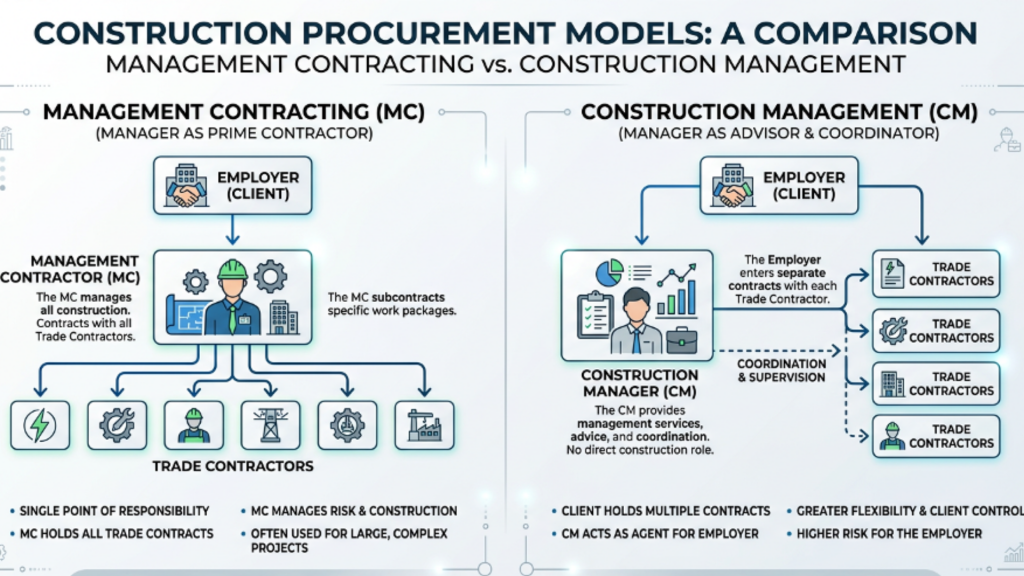
Both Management Contracting and Construction Management separate the role of the “manager” from the “builder.” The fundamental difference lies in the contract structure: under Management Contracting, the manager typically holds the contracts with trade contractors, whereas under Construction Management, the employer holds these contracts directly.
Both models offer several key advantages when deployed correctly:
- Early Contractor Involvement: They allow for the integration of technical expertise during the design development phase, optimizing buildability and sequencing.
- Programme Acceleration: By facilitating fast-track procurement, work packages can commence on site before the total design is finalized.
- Enhanced Transparency: Costs are typically open-book, providing the client with clear visibility into market-tested trade package pricing.
However, these benefits rely on a high level of client engagement and a robust management team. Without it, the “manager-not-builder” model can quickly devolve into a project lacking a clear owner for site-wide integration and safety.
Key Considerations for Project Delivery
While these models share a focus on managing the process rather than executing the work, their risk profiles differ significantly.
1. Contractual Accountability
Management Contracting places the manager in a position of primary responsibility for the works, acting as a “manager-contractor.” Conversely, in Construction Management, the employer acts as the principal, assuming direct responsibility for the performance of individual trade contractors.
2. Risk Allocation
In both models, the employer retains significant design and coordination risk. Because the manager does not usually self-perform the work, the burden of managing interface clashes between, for example, structural steel and mechanical services, falls squarely on the management entity.
3. Cost Certainty
These models offer high transparency but can challenge early cost certainty. Since packages are often tendered as design matures, the final project cost remains fluid for longer than in traditional or Design & Build procurement.
Six Common Challenges in Management-Led Models
- Fragmented Responsibility: When trade contractors are numerous, the lack of a single point of responsibility can lead to disputes regarding site logistics, access, and shared site services.
- Interface Management Gaps: The management entity must be exceptionally disciplined in handling the hand-over points between design-and-build and design-bid-build components.
- Over-Reliance on the Manager: If the management team lacks the necessary commercial and technical competence, the client may be left with significant delivery risks without the protection of a traditional general contractor.
- Scope Gaps in Trade Packages: With many individual contracts, there is a high risk of scope omissions or overlaps that are not discovered until work begins on site.
- Slow Decision-Making: These models require swift, informed client decisions to maintain the momentum of fast-track programmes.
- Inadequate Site Integration: The manager must act as the “glue” for the site; failure to coordinate health and safety, shared plant, and welfare facilities creates significant operational bottlenecks.
A Practical Checklist for Implementation
Before adopting a management-led model, stakeholders should evaluate their capacity and project requirements against these criteria:
- Assess Your Internal Resource: Do you have the professional team or external consultant support to manage multiple trade contracts?
- Define the Risk Appetite: Are you prepared to retain the risk of trade contractor non-performance in exchange for greater control over the process?
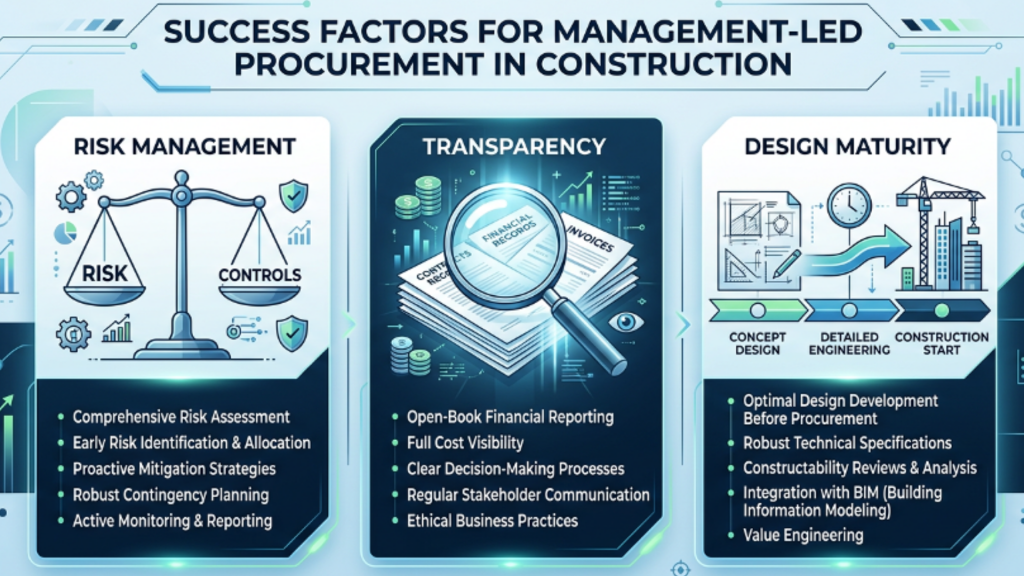
- Establish Robust Governance: Implement clear, rigorous procedures for package procurement, scope delineation, and site coordination.
- Demand Open-Book Reporting: Ensure real-time access to trade contract financial performance and programme progress.
- Prioritize Integration: Mandate that the manager’s scope explicitly covers interface management, shared logistics, and site-wide health and safety.
- Monitor Design Maturity: Use the fluidity of these models to your advantage but set strict milestones for design freeze to avoid endless variations.
Strategic Outlook: Managing the Process
Management Contracting and Construction Management are potent tools for complex, time-sensitive, or highly technical projects. They shift the client from a passive observer to an active participant, providing unparalleled control over quality and procurement.
However, they are not a panacea for poor planning. They demand a sophisticated client, a highly competent management team, and a disciplined approach to scope and integration. When successfully executed, they move the project focus from mere construction to the strategic management of the entire delivery process.
Our Approach
At Harmony CMC, we support Employers, Project Managers, and Contractors in navigating the structural complexities of management-led procurement models. Our approach combines rigorous interface management, transparent commercial reporting, and strategic risk allocation to ensure that the process—and the project—remains under your control.
References
- UK Government (2020). The Construction Playbook: Procurement Strategy. https://www.gov.uk/government/publications/the-construction-playbook
- JCT (2016). Management Contract / Construction Management Documentation. The Joint Contracts Tribunal. https://www.jctltd.co.uk
- CIOB (Chartered Institute of Building). Guide to Construction Management. https://www.ciob.org
- RICS (Royal Institution of Chartered Surveyors). Procurement of Works: Management Contracting and Construction Management. https://www.rics.org
- ICE (Institution of Civil Engineers). Managing Risk in Professional Service Appointments. https://www.ice.org.uk