
Understanding Risk Allocation Shifts and Implications for Employer Protection

The 2017 Second Editions of FIDIC contracts—later amended in the 2022 reprints—represent a pivotal evolution in international construction contracting. Compared to the 1999 editions, the 2017/2022 forms are longer, procedurally detailed, and appear more contractor-friendly in risk allocation. Yet, this evolution ultimately benefits employers by promoting competitive pricing, reducing disputes, and encouraging collaborative project delivery.
The 1999 Framework: Traditional Risk Allocation
In the 1999 Red and Yellow Books, Sub-Clause 17.3 defined Employer’s Risks, covering:
- War, rebellion, terrorism, and civil unrest
- Riot or disorder
- Use of explosives, radiation, or aerial pressure waves
- Employer-provided design or specific design responsibility
- Unforeseeable natural events
These provisions ensured that employers bore risks beyond contractor control, such as political instability or genuinely unpredictable site conditions.
Unforeseen Site Conditions: Sub-Clause 4.12 allowed contractors to claim costs and time extensions for conditions not reasonably anticipated by an experienced contractor. This allocation optimized pricing—contractors priced known and foreseeable risks without padding for unknowable contingencies.
The 1999 Silver Book diverged, shifting almost all risk to contractors—including unforeseen site conditions—reflecting its turnkey philosophy.
Force Majeure Relief: Clause 19 provided relief when “exceptional” events beyond either party’s control prevented performance. Contractors could claim time extensions for all force majeure events, but cost recovery only for specific categories (primarily war risks and natural catastrophes).
The 2017/2022 Revisions: Clarity, Procedures, and Dispute Avoidance
The 2017 editions introduced a procedural revolution: contracts became ~50% longer, with detailed step-by-step requirements to avoid disputes rather than merely resolving them.
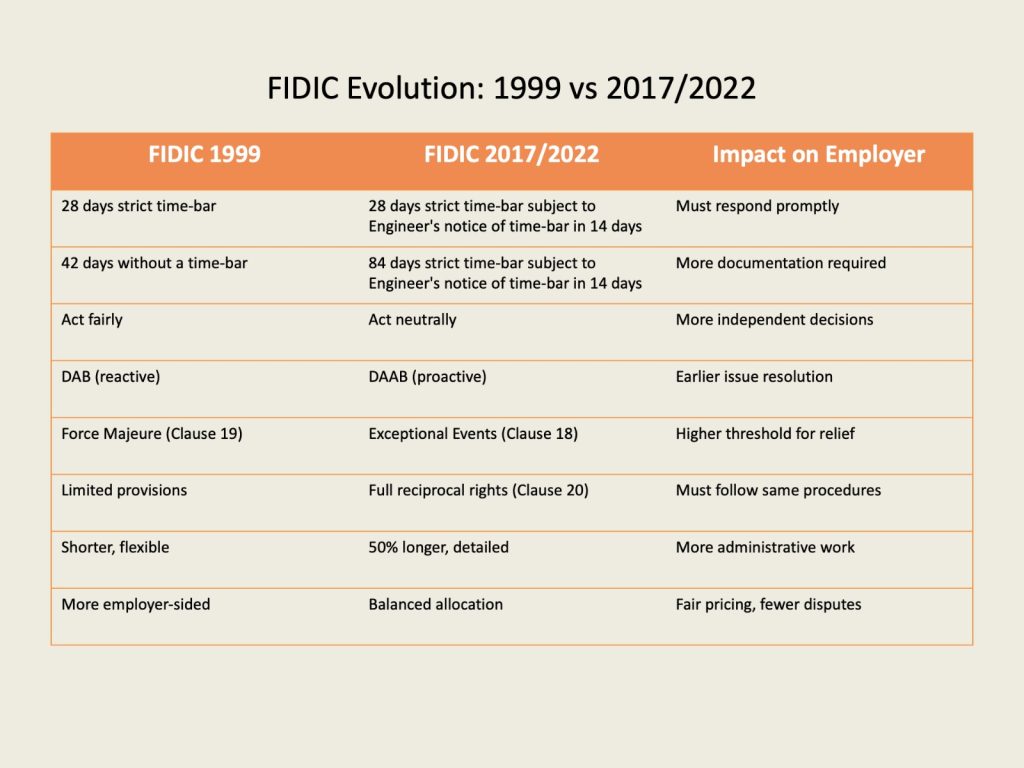
Evolution of FIDIC Contracts: 1999 vs 2017/2022
Key changes showing the shift from employer-sided provisions to balanced, procedurally rigorous frameworks designed for dispute avoidance.
The Driving Philosophy: Dispute Avoidance Over Resolution
FIDIC recognized that the 1999 editions’ relative flexibility led to frequent disagreements over interpretation, notice requirements, and claim substantiation. By introducing detailed procedures, defined timeframes, and explicit consequences for non-compliance, FIDIC aimed to reduce ambiguity and encourage real-time problem-solving.
Core Risk Allocation: Continuity with Refinement
Risk allocation under the 2017 editions largely mirrors 1999 principles:
- Red Book: Design risk remains with the employer
- Yellow Book: Design risk with the contractor
- Silver Book: Contractor assumes most risks
However, the 2017 editions provide substantially more clarity on how these risks operate in practice. For unforeseen site conditions, the Red Book refines the definition of “Unforeseeable” to mean “not reasonably foreseeable by an experienced contractor by the Base Date” (28 days before tender submission). The edition also introduces enhanced procedures for notification and inspection of unforeseen conditions.
Exceptional Events: Force majeure was redefined as “Exceptional Events” under Clause 18. Events must be truly extraordinary, beyond control, not reasonably anticipated, unavoidable, and not attributable to the other party—protecting employers from opportunistic claims.
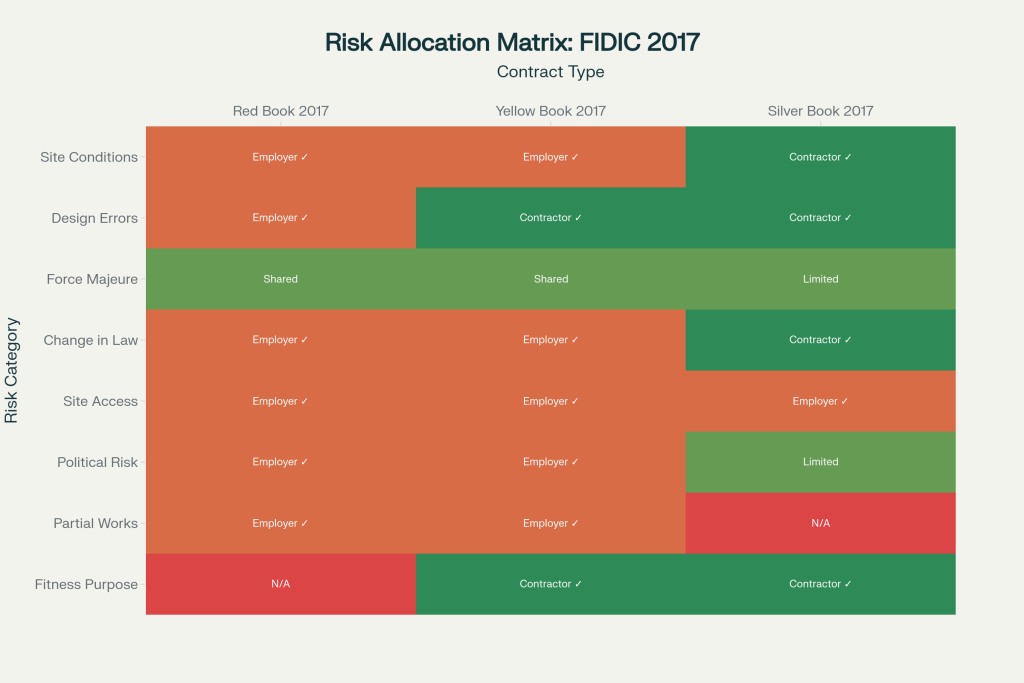
Employer Risk Allocation: Red vs Yellow vs Silver Book 2017
Strategic comparison showing how key risks are distributed across FIDIC’s three primary contract forms.
The Claims Revolution: Procedural Transformation
Notice and Substantiation Requirements:
- Initial Notice of Claim within 28 days of awareness of the event
- Full detailed claim submission within 84 days, including contractual basis, documentation, and quantification
Reciprocal Claim Rights: Employers can now submit claims against contractors using the same procedures, promoting transparency and collaboration.
Engineer’s Enhanced Role: Engineers act neutrally, issuing determinations typically within 42 days. Their independence ensures credible decisions that reduce disputes.
DAAB Proactivity: The Dispute Avoidance/Adjudication Board (DAAB) replaces the 1999 DAB, remaining continuously engaged, monitoring progress, providing guidance, and preventing disputes from escalating. Decisions are binding pending arbitration, ensuring project continuity.
The 2022 Amendments: Fine-Tuning Procedures
The 2022 reprints clarified:
- Claims vs. Routine Matters: Minor disagreements follow streamlined Sub-Clause 3.7 procedures, reducing administrative burden.
- Dispute Definition: Matters must first be referred to the Engineer and receive a Notice of Dissatisfaction before DAAB involvement. Exceptions exist for urgent issues, such as unpaid certificates.
- Conflict Resolution: Parties must notify Engineers of conflicts, ensuring prompt clarification and minimizing escalation.
Strategic Implications for Employers
The evolution from 1999 to 2017/2022 reflects a shift from adversarial, employer-sided contracting toward balanced frameworks:
- Encourages competitive bidding and accurate pricing
- Reduces disputes and claims
- Promotes collaborative project delivery
Employers must develop administrative capabilities: track deadlines, maintain contemporaneous records, prepare substantiations, and select independent Engineers. Overly modifying contracts to create “one-sided” protection often backfires—raising costs, inviting claims, and risking arbitrator scrutiny.
Conclusion: Embracing Evolution for Better Outcomes
The FIDIC 2017/2022 editions demonstrate industry maturation: balanced risk allocation, clear procedures, and independent administration deliver superior outcomes. Employers who embrace this framework experience smoother projects, fewer disputes, and often lower costs.
Understanding the differences between 1999 and 2017/2022 editions enables strategic decisions on contract adoption and administration, turning procedural rigor into a competitive advantage.
At our consultancy, we help clients navigate this evolution—implementing procedures and capabilities that translate FIDIC requirements into certainty, efficiency, and long-term project success.
References
- FIDIC contracts 1999 vs 2017. ID Engineering. https://id.com.eg/fidic-contracts-1999-vs-2017/
- Differences between 1999 and 2017 versions of FIDIC Red Book. LinkedIn. https://www.linkedin.com/pulse/differences-between-1999-2017-versions-fidic-red-book-hilal-koçali
- Comparative Analysis of Employer Risk Allocation in FIDIC 1999 and 2017 Red Books. LinkedIn. https://www.linkedin.com/pulse/comparative-analysis-employer-risk-allocation-fidic-1999-ur-rehman-jelraf
- FIDIC 2022 amendments and reprints: What you need to know. Freshfields Risk & Compliance. https://riskandcompliance.freshfields.com/post/102ichq/fidic-2022-amendments-and-reprints-what-you-need-to-know
- FIDIC 2022 Reprints: 10 Key Areas Of Change In The FIDIC Red Book 2017. Cornerstone Seminars. https://www.cornerstone-seminars.com/blog/fidic-2022-reprints-10-key-areas-of-change-in-the-fidic-red-book-2017/