

In today’s complex construction and engineering environment, selecting the right FIDIC contract is a critical strategic decision. The “Rainbow Suite” of FIDIC forms offers a structured framework to allocate risk, define responsibilities, and align project delivery with stakeholder expectations. Understanding the differences between these contracts helps both employers and contractors achieve predictable, balanced, and successful project outcomes.
The Importance of Contract Selection
The success of any project is closely linked to the clarity of its contractual framework. The right FIDIC contract ensures:
- Efficient risk management: Responsibilities for design, cost, and site conditions are clearly allocated.
- Financial predictability: Proper contract choice ensures cost control and minimizes disputes.
- Operational efficiency: Selecting a contract aligned with project complexity streamlines communication and delivery.
Conversely, an unsuitable form can lead to costly claims, delays, or operational inefficiencies. That’s why choosing the appropriate FIDIC model early in the project lifecycle is essential.
Understanding the FIDIC Suite
FIDIC has developed several standardized contract forms, each represented by a color and designed for specific project types and delivery methods. Together, they form a “Rainbow Suite,” reflecting the spectrum of project conditions in global practice.
Each book distributes design responsibility, site risk, price certainty, and employer control differently.
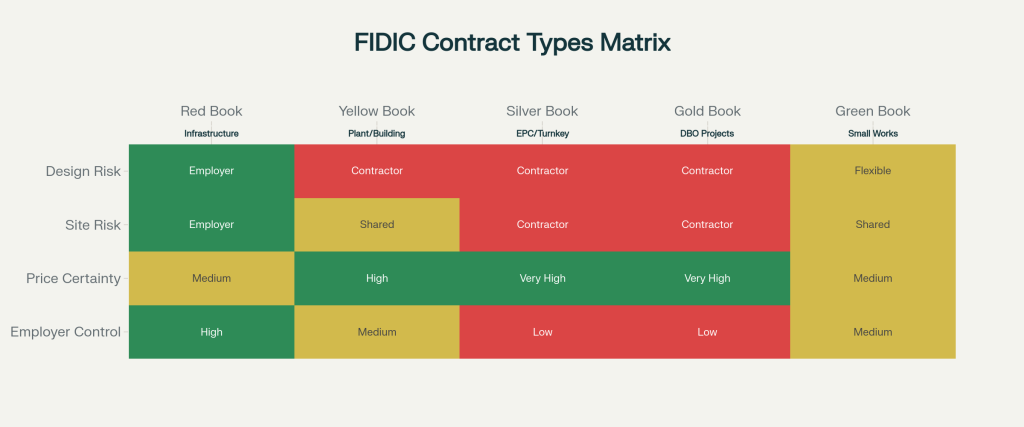
(This matrix visually compares how design risk, site risk, price certainty, and employer control vary across the Red, Yellow, Silver, Gold, and Green Books.)
Overview of Key FIDIC Contract Forms
🔴 Red Book – Conditions of Contract for Construction (for Building and Engineering Works Designed by the Employer)
The Red Book is the most widely used form, suitable for projects where the employer provides the design. The contractor constructs in accordance with the employer’s specifications.
- Design Risk: Employer
- Site Risk: Employer
- Price Certainty: Medium
- Employer Control: High
Best suited for: Traditional infrastructure projects such as roads, bridges, pipelines, and water networks.
This model promotes high employer oversight and design authority but may limit contractor innovation.
🟡 Yellow Book – Conditions of Contract for Plant and Design-Build
Used for projects where the contractor is responsible for both design and execution, based on employer-defined performance requirements.
- Design Risk: Contractor
- Site Risk: Shared
- Price Certainty: High
- Employer Control: Medium
Best suited for: Mechanical, electrical, and process plants, as well as complex building works.
This form encourages innovation but demands contractors with strong design capability.
⚪ Silver Book – Conditions of Contract for EPC/Turnkey Projects
Designed for Engineering, Procurement, and Construction (EPC) contracts where the contractor assumes almost all design and construction risks.
- Design Risk: Contractor
- Site Risk: Contractor
- Price Certainty: Very High
- Employer Control: Low
Best suited for: Power plants, industrial facilities, and international turnkey projects.
The Silver Book offers the highest degree of price certainty but provides the employer with minimal flexibility once execution begins.
🟠 Gold Book – Conditions of Contract for Design, Build, and Operate Projects (DBO)
The Gold Book introduces a long-term operational component, combining design, construction, and operation in a single contract.
- Design Risk: Contractor
- Site Risk: Contractor
- Price Certainty: Very High
- Employer Control: Low
Best suited for: Water and wastewater treatment facilities, long-term public-private partnerships (PPPs), and concession projects.
This model aligns the contractor’s incentives with long-term performance outcomes.
🟢 Green Book – Short Form of Contract
A simplified contract for smaller-scale projects, typically valued under USD 10 million or of short duration.
- Design Risk: Flexible
- Site Risk: Shared
- Price Certainty: Medium
- Employer Control: Medium
Best suited for: Routine maintenance, small civil works, and locally managed construction.
It provides flexibility and ease of administration, especially where time and resources for contract management are limited.
Strategic Considerations in Choosing a FIDIC Contract
Selecting the right FIDIC form requires an assessment of several key project parameters:
- Design Maturity: If the design is fully developed, the Red Book is typically suitable. If not, consider the Yellow or Silver Book.
- Technical Capability: Contractors with robust design expertise may prefer the Yellow or Silver Books.
- Risk Appetite: Employers seeking price certainty should lean toward Silver or Gold; those preferring control should choose Red or Yellow.
- Project Scale and Duration: Smaller projects benefit from the simplicity of the Green Book, while large, long-term investments may favor the Gold Book.
- Operational Requirements: Projects involving post-construction operation phases align best with the Gold Book.
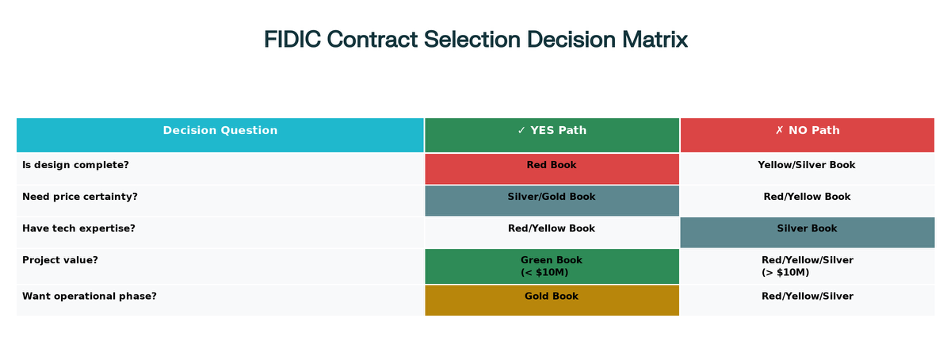
(This decision matrix helps users match project features—such as design completeness, value, and operational needs—with the most appropriate FIDIC form.)
Conclusion
The FIDIC Rainbow Suite remains the global benchmark for fair, transparent, and balanced contracting. Each form represents a unique allocation of responsibility and risk, allowing project teams to tailor their approach based on strategic priorities.
Ultimately, effective contract selection is not just a legal formality—it’s a strategic decision that defines how collaboration, risk, and performance will shape the project’s success.
References
- Different Types of FIDIC Contracts: An In-Depth Exploration. Legittai. https://legittai.com/blog/types-of-fidic-contracts
- FIDIC Contract Types: A Comprehensive Guide. Blackstone Solicitors. https://blackstonesolicitorsltd.co.uk/category/blog/fidic-contract-types-a-comprehensive-guide/
- Comparative Analysis of Employer Risk Allocation in FIDIC 1999 and 2017 Red Books. LinkedIn.
- Which FIDIC Contract should I use? FIDIC. https://fidic.org/bookshop/about-bookshop/which-fidic-contract-should-i-use
- FIDIC contracts – what’s new for 2022? Construction Blog.
- FIDIC Red, Yellow, and Silver Books – Institute of Construction Claims Practitioners.
- Risk Allocation in Different FIDIC Contract Forms. Academia.edu.
- Understanding Risk Allocation in FIDIC Construction Contracts. International Arbitration Attorney.
- The FIDIC Design Build and Operate Contract – Gold Book. Dr. Hoek.
- FIDIC 2017: Employer and Contractor Claims. International Construction Knowledge Hub.