Why a Pandemic-Era Buzzword Rarely Excuses Performance, and What Actually Does

For a few months in 2020, “force majeure” was the most quoted phrase in construction. Sites closed, supply chains seized, labour could not travel, and parties across the industry reached for the clause they assumed would excuse late or non-performance. Many were disappointed. The pandemic did not rewrite the law; it tested it, and it exposed how little the phrase means in the abstract.
The lasting lesson of COVID-19 is that force majeure is not a general safety valve. Under English law it is not a legal doctrine at all; it means only what the particular contract says it means. Under the civil-law systems of the Gulf it is a statutory concept, but a narrow one, triggered by genuine impossibility rather than by difficulty or expense. In both systems the party invoking it carries a heavy burden, and an event that merely makes a contract harder or less profitable almost never qualifies.
The question to ask is therefore not “is this a force majeure event?” in the abstract, but “what does our clause actually cover, what does the governing law require, and can we prove that this event prevented performance rather than merely disrupting it?” The principles are clearest in the English authorities, which remain a common choice of governing law in international construction; but the civil-law systems that govern most projects across the Gulf answer the same question differently, and in one important respect more generously. This article looks at both.
What Force Majeure Actually Means
There is a common assumption that “force majeure” is a recognised legal category with fixed content. Under English law it is not. The term is a creature of French law, and English law attaches no general doctrine to it: it means whatever the clause that contains it says it means, and where a contract has no force majeure clause, the concept simply does not arise.
This is why the drafting matters so much. A well-drafted clause lists or defines the qualifying events, states what the affected party must do, and sets out the relief, usually an extension of time, and sometimes suspension or, after a prolonged event, termination. The international standard forms illustrate the point. The FIDIC conditions are one of the few standard forms to define the concept: an exceptional event or circumstance beyond a party’s control, which it could not reasonably have provided against, could not reasonably have avoided or overcome, and which is not substantially attributable to the other party; the 2017 FIDIC forms renamed the mechanism “Exceptional Events”, but the substance is similar. Other common forms treat the subject quite differently: the JCT contracts use the words “force majeure” as a ground for extension of time but do not define them, while the traditional ICE conditions did not use the term at all. The practical consequence is that two projects hit by the same event can reach opposite outcomes, purely because their clauses, and their governing law, are different.
Three Words That Are Not Interchangeable
Much of the confusion after COVID-19 came from treating three distinct ideas as one.
Force majeure is contractual. It depends on a clause, and it delivers whatever that clause provides, typically time rather than money. No clause, no force majeure.
Frustration is the English law doctrine that applies where there is no applicable clause. It discharges a contract automatically when an unforeseen event makes performance impossible, or radically different from what was agreed, through no fault of either party. Its bar is extremely high: increased cost, scarcity of labour or materials, and loss of profit do not frustrate a contract, and the doctrine is applied narrowly precisely so that parties cannot escape a bad bargain by calling it an act of fate.
Hardship is a civil-law concept with no true English equivalent. Where an unforeseen, exceptional event makes performance excessively onerous but still possible, the codes of the Gulf allow a court to step in and rebalance the obligation rather than discharge it. English law offers nothing comparable: short of frustration, a contract that has merely become ruinous must still be performed.
Keeping these three apart is the single most useful discipline in this area. A party with no force majeure clause cannot manufacture one; a party facing mere expense cannot reach frustration; and a party on a Gulf project may have a hardship remedy that an English-law contract would never provide.
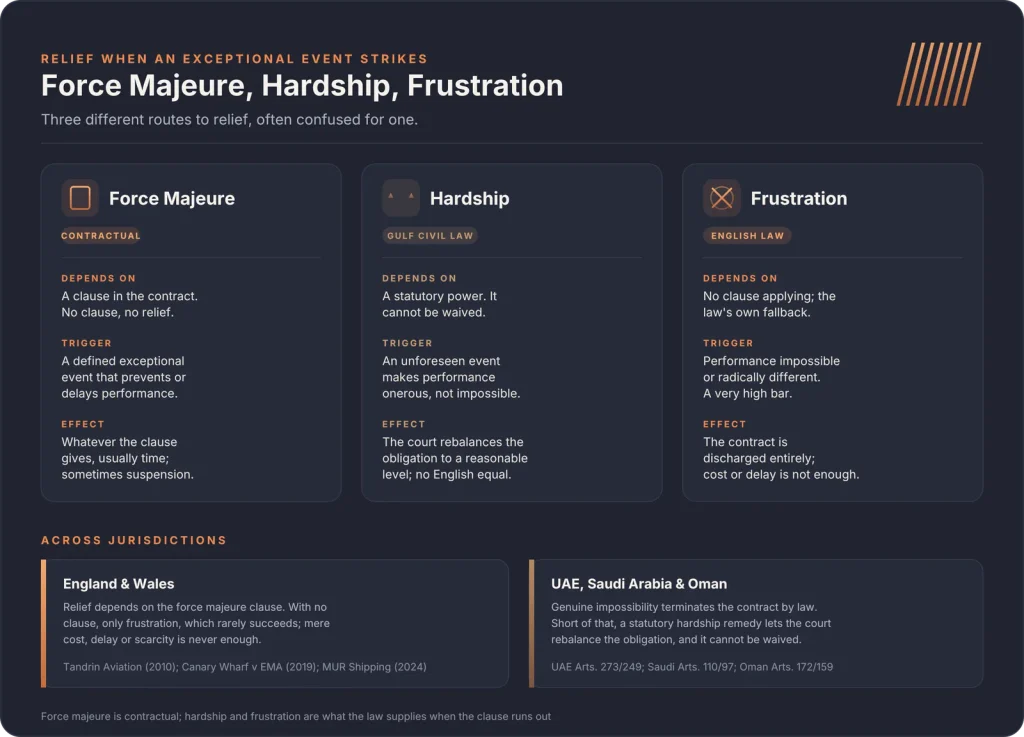
Figure 1: Three different routes to relief. Force majeure comes from the clause; hardship and frustration are what the law supplies when the clause runs out.
Why COVID-19 Changed Fewer Outcomes Than Expected
The pandemic produced a great deal of force majeure correspondence and very little successful reliance, and the reasons are instructive.
First, economic consequences are not force majeure. Long before the pandemic, the English courts held that a change in market or economic circumstances, even a dramatic one, does not trigger a force majeure clause. In Tandrin Aviation Holdings Ltd v Aero Toy Store LLC, the “unanticipated, unforeseeable and cataclysmic downward spiral of the world’s financial markets” was held not to be a force majeure event. The same logic defeated most pandemic arguments built on cost, delay or reduced profitability rather than genuine prevention.
Second, causation must be proved. A force majeure clause is engaged only where the event actually prevented, hindered or delayed performance, according to the wording used, and the party relying on it must show that link. An event happening in the background while performance remained possible is not enough; where a clause requires that performance was “prevented”, the courts have required something close to impossibility, not mere difficulty.
Third, the clause is read strictly, including its provisos. In RTI Ltd v MUR Shipping BV, the Supreme Court considered a force majeure clause requiring the affected party to use “reasonable endeavours” to overcome the event, and held that reasonable endeavours did not oblige that party to accept an offer of non-contractual performance in place of what the contract required. The obligation to mitigate does not extend to surrendering the bargain itself.
Fourth, where there is no clause, frustration rarely rescues anyone. In Canary Wharf (BP4) T1 Ltd v European Medicines Agency, the tenant argued that the United Kingdom’s departure from the European Union frustrated its lease; the court disagreed. Even a profound, unforeseen change in circumstances will seldom meet the frustration threshold, and a contract is not discharged merely because performance has become unwelcome or uneconomic.
The law was not suspended during the pandemic; it was applied, and it set the bar where it had always been.
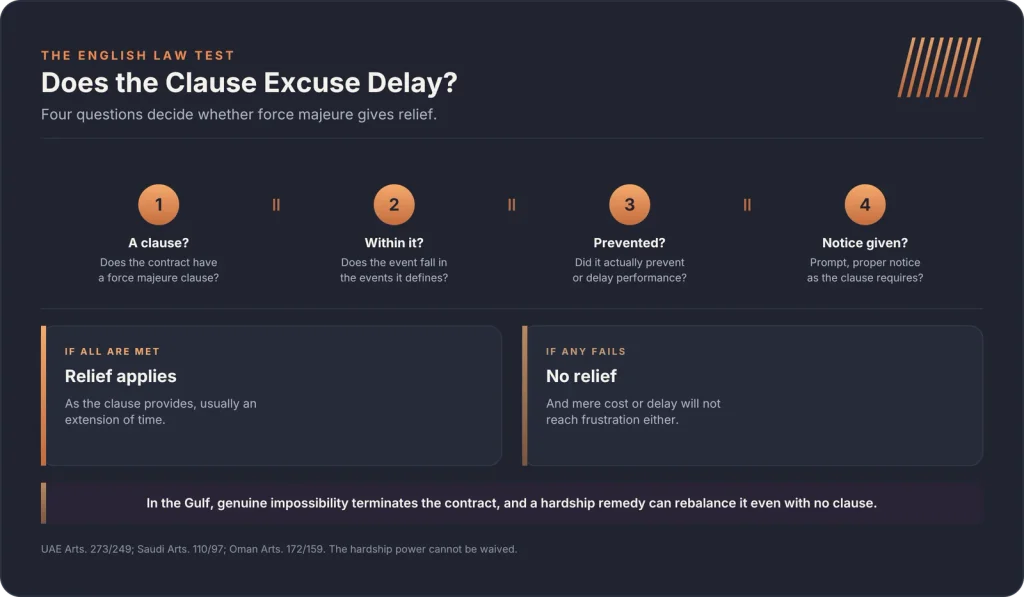
Figure 2: The English law test. Force majeure gives relief only where a clause covers the event, the event actually prevented performance, and notice was properly given.
Where Force Majeure Claims Fall Apart
The difficulties in this area are rarely about whether an event was serious. They are about proof, procedure and drafting.
The most common failure is hardship dressed up as force majeure. A project that has become slower, costlier or less profitable has suffered real harm, but under English law that harm is not, by itself, a force majeure event, and it is nowhere near frustration; framing a cost-and-delay problem as force majeure invites a quick rejection. Closely related is weak causation: the party must show that the event, as defined in the clause, actually caused the prevention or delay claimed, separated from its own performance problems and from ordinary commercial risk, and contemporaneous records of what the event stopped, and when, are what make or break the argument.
Notice and procedure are frequently mishandled. Force majeure clauses almost always require prompt notice, often within a defined period, and sometimes updating notices and mitigation steps as a condition of relief; a good claim can be lost by a missed or late notice, in the same way a delay claim can be lost by a defective extension-of-time notice.
The governing law is often overlooked until it is too late. A clause, and a strategy, that work under English law may produce a very different result under a Gulf civil code, where impossibility terminates the contract automatically and a hardship remedy may exist even without a clause. Supply-chain disruption deserves particular care here: the pandemic made “supply chain” a shorthand for excuse, but a shortage of materials or a supplier’s own default is generally treated as ordinary commercial risk rather than force majeure unless the clause expressly says otherwise. Allocating that risk clearly at the drafting stage is far safer than arguing about it afterwards.
The Position in the Gulf: the UAE, Saudi Arabia and Oman
The same question is worth examining in the Gulf, where most construction projects are governed by codified civil-law systems. Here force majeure is not merely a matter of what the parties wrote; it is a statutory concept, and it sits alongside a second, distinct form of relief that English law does not offer.
Two ideas run through all three codes. The first is force majeure in the strict sense: where an exceptional event makes performance genuinely impossible, the obligation is extinguished and the contract is terminated by operation of law, with partial or temporary impossibility discharging or suspending the affected part. The bar is impossibility, not difficulty, so a pandemic that slows or burdens a project without making performance impossible will usually fall short. The second idea is hardship, or “exceptional circumstances”: where an unforeseen, general event makes performance excessively onerous but still possible, the court may intervene to reduce the obligation to a reasonable level rather than end the contract, and this hardship power generally cannot be excluded by agreement.
In the United Arab Emirates, force majeure and impossibility discharge the obligation and terminate the contract, while the hardship provision allows a court to bring an excessively burdensome obligation back to a reasonable level where unforeseen general events threaten the debtor with grave loss; any agreement to exclude that power is void. These provisions, long familiar as Articles 273 and 249 of the 1985 Civil Code, are carried forward, under renumbered provisions, into the new Civil Transactions Law (Federal Decree-Law No. 25 of 2025), in force since 1 June 2026. Saudi Arabia, under the Civil Transactions Law (Royal Decree No. M/191) in force since 16 December 2023, addresses impossibility of performance as a ground of termination (Article 110) and provides a separate hardship regime (Article 97); the Saudi provision is distinctive in requiring the parties to attempt to renegotiate before the court intervenes, and a request to renegotiate does not entitle the affected party to stop performing. Oman follows the same pattern under the Civil Transactions Law (Royal Decree No. 29 of 2013): impossibility extinguishes the obligation and terminates the contract (Article 172), while the hardship provision (Article 159) allows the court to adjust an obligation that has become excessively onerous but not impossible, and that power is mandatory and cannot be contracted out of.
The practical contrast with English law is significant. Under English law, a party without a force majeure clause is left with frustration, a remedy that almost never succeeds, and a contract that has merely become onerous must still be performed in full. Under the Gulf codes, genuine impossibility ends the contract automatically whether or not a clause says so, and, short of impossibility, a hardship remedy may allow the court to rebalance a contract that an English court would leave untouched. Standard international forms such as FIDIC, widely used across the region, operate on top of these mandatory code provisions rather than displacing them, so a FIDIC force majeure or exceptional-events clause does not remove the parties’ underlying statutory rights, and specific local-law advice is essential because the remedy depends on the governing law of the particular contract.
Harmony’s Perspective
In our experience, force majeure disputes are rarely won or lost on whether an event was dramatic. They are decided by the clause, the records, the notices and the governing law, all of which are settled long before the event occurs.
- reading the force majeure clause as the starting point, since under English law the concept means only what the clause says and delivers only the relief it provides;
- distinguishing clearly between force majeure, frustration and hardship, so a cost-and-delay problem is not argued as something the governing law will not recognise;
- proving causation with contemporaneous records that show what the event actually prevented or delayed, not merely that it occurred;
- treating notice and procedure as conditions of relief, serving prompt and properly particularised notices rather than assuming the event speaks for itself;
- reading the clause against the governing law, since the Gulf codes terminate on genuine impossibility and provide a hardship remedy, unwaivable, that English law does not;
- allocating supply-chain and cost risk expressly at the drafting stage, rather than relying on force majeure to absorb what is usually ordinary commercial risk.
Above all, force majeure is an allocation of risk agreed in advance, not an emergency exit discovered after the event. The clause that helps in a crisis is the one that was drafted with the crisis in mind.
Six Questions Before You Rely on It
Before invoking force majeure, or defending against it, project teams should be able to answer the following:
- Does the contract contain a force majeure clause, and does the event fall within the events it actually defines or lists?
- Can you show that the event prevented, hindered or delayed performance as the clause requires, rather than merely making it harder or costlier?
- Have the notice and procedural requirements been met, promptly and in the required form?
- Is the problem really hardship or economic loss, which force majeure and frustration will not cover under English law?
- On a Gulf project, under the UAE, Saudi or Omani civil codes, have the statutory rules on impossibility and the unwaivable hardship remedy been taken into account, whatever the contract says?
- Has supply-chain and cost risk been allocated expressly, rather than left to a force majeure argument after the event?
COVID-19 did not expand force majeure; it revealed how narrow it already was. The concept is only as wide as the clause that contains it, it will not absorb mere cost or delay, and where there is no clause the English fallback of frustration almost never applies, though the Gulf codes add a hardship remedy that English law does not. The question is never simply whether an event was exceptional, but whether the contract and the governing law actually provide relief for it, a question best answered before the event, with the records kept while it unfolds.
References
- Tandrin Aviation Holdings Ltd v Aero Toy Store LLC [2010] EWHC 40 (Comm).
https://www.bailii.org/ew/cases/EWHC/Comm/2010/40.html - Canary Wharf (BP4) T1 Ltd v European Medicines Agency [2019] EWHC 335 (Ch).
https://www.bailii.org/ew/cases/EWHC/Ch/2019/335.html - RTI Ltd v MUR Shipping BV [2024] UKSC 18.
https://www.bailii.org/uk/cases/UKSC/2024/18.html - United Arab Emirates. Civil Transactions Law (Federal Decree-Law No. 25 of 2025), in force 1 June 2026 (force majeure and impossibility; hardship, which cannot be excluded by agreement; formerly Articles 273 and 249 of the 1985 Civil Code).
https://uaelegislation.gov.ae/en/legislations/4011 - Kingdom of Saudi Arabia. Civil Transactions Law (Royal Decree No. M/191 of 1444H), in force 16 December 2023 (impossibility of performance, Article 110; exceptional circumstances / hardship, Article 97).
https://laws.moj.gov.sa/en/legislation/PBbHmywh1XMp-Kyv3NtQLg - Sultanate of Oman. Civil Transactions Law (Royal Decree No. 29 of 2013), Article 172 (impossibility) and Article 159 (hardship, which cannot be excluded by agreement).
https://qanoon.om/p/2013/rd2013029/ - FIDIC. Conditions of Contract for Construction (Red Book, 2nd ed., 2017), Clause 18 (Exceptional Events).
https://fidic.org/bookshop