
How a Delay Damages Clause Stays Enforceable, and When It Risks Being Struck Down or Reduced

Liquidated damages are among the most familiar provisions in any construction contract. A fixed sum, payable for each day or week that completion is late, is agreed when the contract is signed. It spares the employer the difficulty of proving what the delay actually cost, and it tells the contractor exactly what late completion will mean. Used well, the clause gives both sides certainty before a single day of delay has occurred.
That certainty, however, is not guaranteed. A clause that fixes a figure with no rational connection to the consequences of delay can be challenged, and the way it is challenged depends entirely on the law that governs the contract. Under English law, the danger is that the clause is held to be a penalty and struck down altogether. Under the civil-law systems of the Gulf, the danger is different: the clause survives, but a court or tribunal may reduce the figure. In both cases, the protection the clause was meant to provide can fall away at the very moment it is needed.
The question for any project team is therefore not simply whether the contract fixes a figure for delay, but whether that figure will actually hold when it is tested.
What Liquidated Damages Are, and What a Penalty Is
A liquidated damages clause fixes, in advance, the compensation payable on a defined breach. In construction, that breach is almost always late completion, and the sum is usually expressed as a rate per day or per week of delay. Its purpose is compensatory: it stands in place of the damages the employer would otherwise have to prove, and it is recoverable without evidence of the actual loss suffered. For the employer it secures a predictable remedy; for the contractor it caps and clarifies the exposure being taken on.
A penalty is something different in character. It is a sum designed not to compensate the innocent party but to punish the party in breach, or to pressure it into performing, by threatening a payment out of all proportion to the real consequences of the breach. The old authorities described such clauses as operating “in terrorem” of the contract-breaker.
The distinction matters because the two are treated very differently once a dispute begins. A genuine liquidated damages clause is a tool of certainty. A clause that crosses the line into a penalty is, under English law, a liability waiting to collapse.
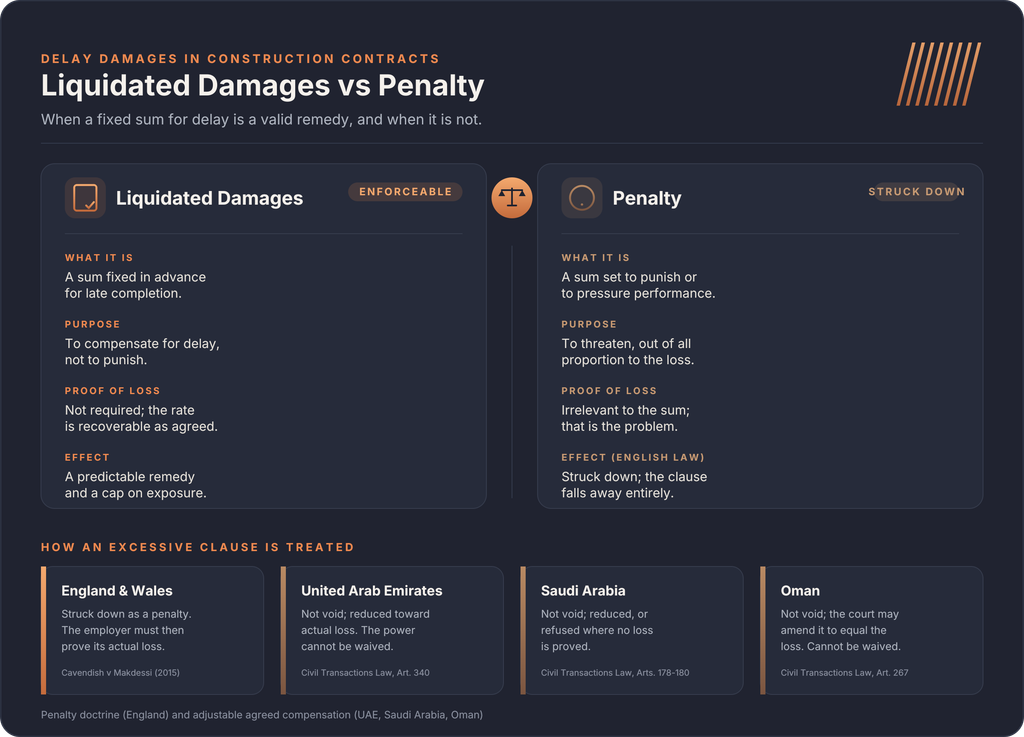
Figure 1: Liquidated damages set out to compensate; a penalty sets out to punish. How an excessive clause is then treated depends on the governing law.
The English Law Test: Legitimate Interest, Not a Pre-Estimate
For most of the last century, the dividing line was drawn by Dunlop Pneumatic Tyre Co Ltd v New Garage and Motor Co Ltd. A clause was enforceable if it represented a genuine pre-estimate of the likely loss, and penal if the sum was extravagant and unconscionable compared with the greatest loss that could conceivably follow from the breach.
That framework was reformulated by the Supreme Court in Cavendish Square Holding BV v Talal El Makdessi, heard together with ParkingEye Ltd v Beavis. The modern question is no longer simply whether the figure was a pre-estimate of loss. It is whether the clause imposes on the party in breach a detriment “out of all proportion to any legitimate interest” of the innocent party in the enforcement of the primary obligation. If it does, it is penal and unenforceable. The innocent party’s legitimate interest can extend beyond the recovery of its own financial loss, so a clause is not penal merely because the agreed sum is larger than the loss likely to be suffered. The rule also bites only on secondary obligations, meaning those triggered by a breach, and does not allow a court to rewrite the main commercial bargain.
The consequence of crossing the line is significant. If a delay damages clause is held to be a penalty, it is not adjusted downward to a reasonable figure; it falls away entirely. The employer is then left to recover general, unliquidated damages, which means proving the actual loss caused by the delay, exactly the exercise the clause was meant to avoid. A valid liquidated damages clause, by contrast, is enforced at the agreed figure whether the real loss turns out to be higher or lower.
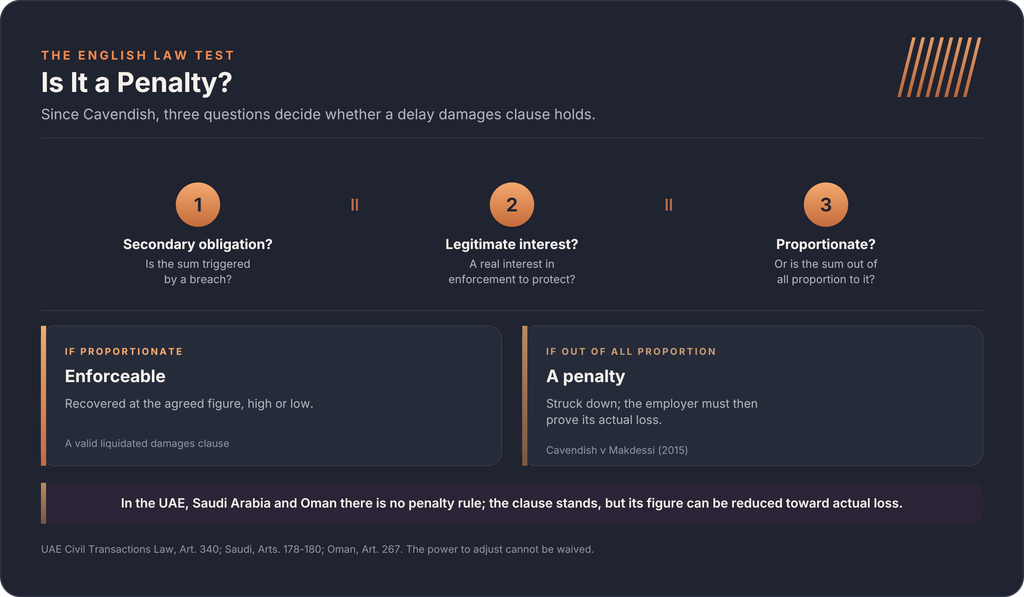
Figure 2: The Cavendish test. A clause is penal only where it is out of all proportion to a legitimate interest; otherwise it stands at the agreed figure.
A separate but related question is what happens on termination. In Triple Point Technology Inc v PTT Public Company Ltd, the Supreme Court confirmed the orthodox position: unless the clause clearly provides otherwise, liquidated damages for delay accrue up to the date of termination, those accrued rights survive termination, and the employer claims general damages for the period after termination. The decision restored a commercially sensible default and underlined why clear drafting of the clause matters.
Where the Risks Begin
The risks in this area tend to arise not from the concept of liquidated damages, which is sound, but from how the clause is set and supported.
The most direct risk is an indefensible rate. A figure chosen as a round number, or set deliberately high to pressure the contractor, invites a penalty challenge under English law and a reduction under the civil codes discussed below. A rate that can be explained by reference to the consequences the employer genuinely expected from delay is far more secure than one that cannot.
A second, often overlooked, risk sits in how the clause is expressed. A delay damages rate left blank, or stated as nil, may be read not as an absence of any remedy but as a positive agreement that no damages are payable for delay at all, barring even a general damages claim. What looks like a gap can operate as an exhaustive remedy of zero.
Third, the right to deduct delay damages can be lost through the contract’s own machinery. Where the employer causes or contributes to delay and the extension-of-time provisions do not allow that delay to be dealt with, the prevention principle can set time “at large”, leaving the contractor obliged only to complete within a reasonable time and the liquidated damages regime unenforceable. A robust and properly operated extension-of-time mechanism is what keeps the right to deduct alive.
Finally, liquidated damages are easily misread as a one-way benefit to the employer. In practice the clause usually works as a cap as well as a floor: if the employer’s actual delay loss turns out to exceed the liquidated figure, recovery is generally limited to that figure. The rate therefore needs to reflect the risk the employer is genuinely prepared to carry, not only the pressure it wishes to apply.
The Position in the Gulf: the UAE, Saudi Arabia and Oman
The same question is worth examining in the Gulf, where most construction projects are governed by codified civil-law systems. Here the approach is fundamentally different, and the difference is important for anyone relying on a delay damages clause.
Civil-law systems in the region do not have a doctrine that voids a clause for being a penalty. Agreed compensation is valid in principle, whatever it is called. What the codes give the court or tribunal instead is a power to adjust the agreed figure to reflect the actual loss, and, critically, that power generally cannot be excluded by agreement.
In the United Arab Emirates, the position is now set out in Article 340 of the new Civil Transactions Law (Federal Decree-Law No. 25 of 2025), in force since 1 June 2026, which replaced the long-standing Article 390 of the 1985 code. Parties may still fix compensation in advance, and the employer need not prove its loss to claim it. But a court or tribunal may reduce the agreed sum where the debtor proves it is exaggerated, where the obligation has been partly performed so that the agreed amount exceeds the real loss, or where the creditor contributed to the loss by its own fault. The agreed figure may be exceeded only where the creditor proves fraud or gross fault on the part of the debtor. The power to adjust cannot be contracted out of.
Saudi Arabia reached a comparable position through its first codified Civil Transactions Law (Royal Decree No. M/191), in force since 16 December 2023. Under Articles 178 to 180, parties may agree compensation in advance, but on the debtor’s application the court may reduce it where it is shown to be excessive or where the obligation was partly performed, and may decline to award it at all where the debtor proves that the creditor suffered no actual loss. As in the UAE, the agreed figure may be increased only on proof of fraud or gross error. The approach reflects the Sharia principle that compensation follows actual harm, and the court acts only when a party asks it to, not of its own motion.
Oman takes the same approach, and expresses it in particularly clear terms. Under Article 267 of the Civil Transactions Law (Royal Decree No. 29 of 2013), the parties may fix compensation in advance, but on the application of either party the court may amend that figure “to make the compensation equal to the damage”, and any agreement to the contrary is null and void. The power therefore runs in both directions in principle, although in practice a reduction toward the real loss is far more common than an increase, since the employer usually sets the rate and the contractor prices against it. As elsewhere in the Gulf, the court does not act of its own motion: a contractor facing delay damages that exceed the loss actually suffered must apply for the figure to be reduced, and must be ready to put the evidence of actual loss before the court or tribunal. Where a contract carries multiple delay-damages milestones, each may need to be examined against the loss attributable to it, rather than treated as a single aggregate deduction.
The practical contrast with English law is sharp. Under English law a valid clause is enforced at its face value regardless of the real loss, while an excessive clause is struck down entirely and the employer must prove its loss from scratch. Under the Gulf codes the clause is not struck down, but the figure is adjustable toward the actual loss, and that adjustment cannot be waived. The label “penalty” therefore carries far less weight in the Gulf than the evidence of what the delay actually cost. Standard international forms such as FIDIC, whose delay damages provisions are used widely across the region, operate on top of these mandatory rules rather than displacing them, and specific local-law advice is essential because the remedy depends on the governing law of the particular contract.
Harmony’s Perspective
In our experience, the certainty that liquidated damages are supposed to deliver is won or lost at the drafting stage, long before any delay occurs. The clause is only as strong as the thinking and the record behind it.
- fixing the delay damages rate on a defensible, documented basis at the time of contracting, rather than a round figure or a deterrent sum that cannot be explained to a tribunal later;
- keeping the extension-of-time machinery sound and operating it properly, because a failed regime can set time at large and lose the right to deduct delay damages altogether;
- recognising that a liquidated damages clause usually caps the employer’s delay recovery as well as fixing it, so the rate should reflect the risk the employer is genuinely accepting;
- reading the clause against the governing law, since an excessive figure is struck down entirely under English law but adjusted toward actual loss, unwaivably, under the UAE, Saudi and Omani civil codes;
- keeping evidence of actual delay-related loss even where a liquidated sum applies, because that evidence is what decides any later challenge to the figure, under either system.
Above all, a delay damages clause should be treated as a considered allocation of risk, not as a bargaining threat. The clause that survives scrutiny is the one that was realistic to begin with.
Key Takeaways
Before relying on a liquidated damages clause, project teams should be able to answer the following questions:
- Is the delay damages rate supported by a rational basis that could be explained to a court or tribunal?
- Under English law, could the figure be attacked as out of all proportion to any legitimate interest, and therefore penal?
- Does the clause preserve the right to liquidated damages up to termination, with general damages available thereafter?
- Is the extension-of-time machinery sound enough to keep the right to deduct delay damages intact?
- On a Gulf project, under the UAE, Saudi or Omani civil codes, has the court’s or tribunal’s unwaivable power to adjust the agreed figure toward actual loss been taken into account?
- Where the contract sets several delay-damages milestones, has each been considered against the loss attributable to it, rather than as one aggregate figure?
- Is evidence of actual delay loss being kept, whichever law governs the contract?
Answering these questions when the contract is drafted is far cheaper than confronting them once a delay claim is live.
Conclusion
Liquidated damages remain one of the most valuable tools in construction contracting. They give certainty, remove the burden of proving loss, and cap the exposure both sides are taking on. But all of that depends on one thing: the clause being enforceable when it is finally tested.
The risk takes different forms in different systems. Under English law, an excessive clause is struck down as a penalty, and the employer is thrown back on proving its actual loss. Under the civil codes of the UAE, Saudi Arabia and Oman, the clause is not void, but the figure can be adjusted toward the real loss, and that power cannot be signed away. In either case, an unrealistic rate or weak supporting machinery undermines the very certainty the clause was meant to secure.
The difference between a liquidated damages clause and a penalty is not a drafting technicality. It is the difference between a remedy that holds and one that fails. The question is never simply whether the contract fixes a figure for delay, but whether that figure will survive the test applied by the law that governs it.
References
- Dunlop Pneumatic Tyre Co Ltd v New Garage and Motor Co Ltd [1915] AC 79 (HL).
https://www.bailii.org/uk/cases/UKHL/1914/1.html - Cavendish Square Holding BV v Talal El Makdessi; ParkingEye Ltd v Beavis [2015] UKSC 67.
https://www.bailii.org/uk/cases/UKSC/2015/67.html - Triple Point Technology Inc v PTT Public Company Ltd [2021] UKSC 29.
https://www.bailii.org/uk/cases/UKSC/2021/29.html - United Arab Emirates. Civil Transactions Law (Federal Decree-Law No. 25 of 2025), in force 1 June 2026 (agreed compensation, Article 340).
https://uaelegislation.gov.ae/en/legislations/4011 - Kingdom of Saudi Arabia. Civil Transactions Law (Royal Decree No. M/191 of 1444H), in force 16 December 2023 (agreed compensation, Articles 178 to 180).
https://laws.moj.gov.sa/en/legislation/PBbHmywh1XMp-Kyv3NtQLg - Sultanate of Oman. Civil Transactions Law (Royal Decree No. 29 of 2013), Article 267 (agreed compensation and the court’s power to amend it to equal the actual loss).
https://qanoon.om/p/2013/rd2013029/ - FIDIC. Conditions of Contract for Construction (Red Book, 2nd ed., 2017), Sub-Clause 8.8 (Delay Damages).
https://fidic.org/bookshop