
Where the Line Falls Between a Binding Bargain and Unfair Advantage in Construction Tendering

Tendering is competitive, document heavy, and almost always done under time pressure. Prices are built from hundreds of line items, scope is interpreted from evolving information, and estimators work to deadlines that leave little room for a final sanity check. In that environment, pricing and scope errors are not rare events; they are a predictable feature of the process.
The instinctive assumption is that a tender, once accepted, is binding, and that a contractor who misprices its bid must live with the consequences. As a general rule, that is correct. A party is expected to stand behind the figure it submits, and the employer is under no duty to protect a tenderer from its own arithmetic.
The harder question arises when the mistake is obvious, and the party receiving the tender notices it but stays silent, hoping to lock in a price that is clearly too good to be true. At that point the law stops asking simply whether the tenderer made an error, and starts asking a different question: did the other party know, and did it behave as an honest party would have behaved?
The principles are illustrated most clearly by English case law, which remains a common choice of governing law in international construction. But the same question arises, and is answered in strikingly similar terms, under the civil-law systems that govern most projects across the Gulf. This article looks at both.
The General Rule: A Tenderer Bears Its Own Error
A binding contract comes into being when an unambiguous offer receives an unconditional acceptance. Where a tender or quotation containing an error is accepted in that way, the general rule is that the error cannot afterwards be corrected. If the mistake produces a loss, the tenderer normally sustains it.
This reflects a deliberate commercial policy. There is an ordinary freedom to accept, reject, or negotiate a tender as the recipient sees fit, and certainty of bargain is valued highly. An employer or main contractor is entitled to accept a keen price without becoming the guarantor of the tenderer’s estimating.
The point is well illustrated by Henry Boot Construction (UK) Ltd v Alstom Combined Cycles Ltd, where a contractor had made an error that left a contract rate significantly higher than it should have been. When that rate was carried into the valuation of varied work, it produced a windfall. The Court of Appeal held that the agreed contract rates governed, and that a rate is not to be set aside merely because it is mistaken or uneconomic. The court did note a limit: a rate producing “a ludicrous result” from a gross error may not be a reasonable basis for valuing other work. But the starting position is clear. Mistaken or not, the rate the parties agreed is generally the rate that binds them.
For most tender errors, then, certainty prevails and the risk sits with the party that made the mistake.
The Exception: A Known Mistake Cannot Be Snatched
The general rule has an important limit. Where the party receiving a tender actually knows, or ought to have known, that it contains an obvious error, and stays silent in order to take advantage of it, the courts will intervene. This is the law of unilateral mistake, and it prevents one party from exploiting an error it has plainly spotted.
The classic statement is Hartog v Colin & Shields, where goods were offered at a price per pound rather than, as negotiations had assumed, per piece. The buyer tried to hold the seller to the mistaken figure. The court held that a party cannot “snap up” an offer it knows to be the product of a mistake; no binding contract arose on those terms.
The principle was applied directly to construction tendering in Traditional Structures Ltd v HW Construction Ltd. A subcontractor was asked to quote for steelwork and roof cladding. Through an estimating error, the quotation it issued set out only the steelwork price; the cladding price, a substantial sum, was left out. The main contractor accepted the quotation and later refused to pay separately for the cladding, arguing that the single price covered everything.
The court found against the main contractor and ordered rectification of the contract to include the omitted cladding price, together with a reasonable sum for the work. What decided the case was conduct. The quotation, properly read, pointed to more than one price and should have prompted an enquiry. The main contractor had avoided referring to the price in correspondence, had worded a query so that it appeared to relate only to the steelwork, and, unlike every other subcontract it placed, had omitted the contract sum when confirming the order. Taken together, this was not the behaviour of a party that honestly believed the price covered the cladding. It was a party that had recognised the error and tried to benefit from it.
The test the courts apply is therefore practical: was there an error; was it obvious; and did the recipient fail to do what an honest party would have done, which is to raise it before accepting?
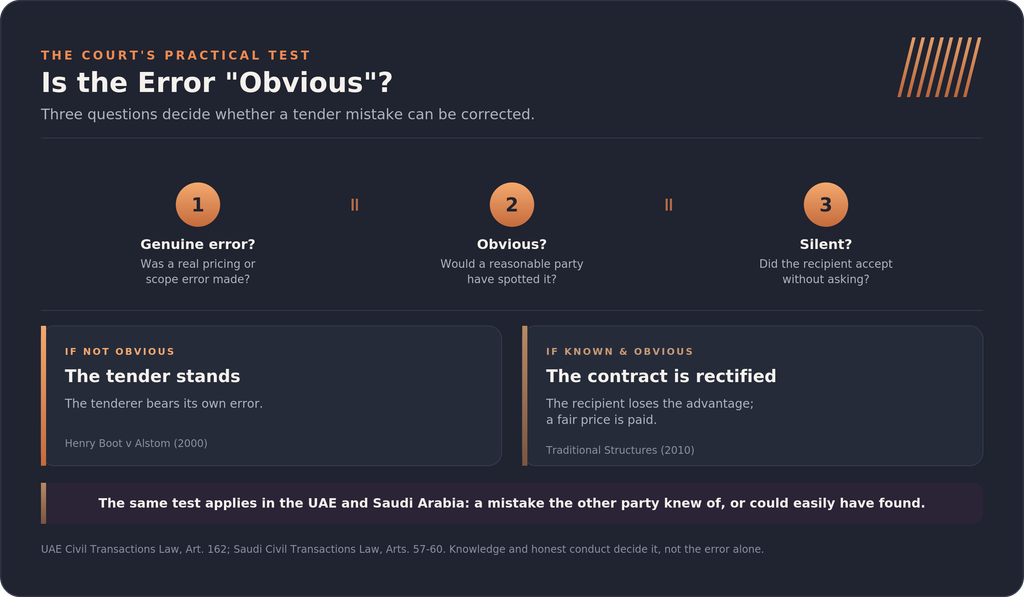
Figure 1: The general rule and its limit. The dividing line is knowledge; an obvious error the recipient knew of, or should have queried, changes the outcome.
Where the Risks Begin
The difficulty is that the line between accepting a genuinely keen price and unfairly exploiting a mistake is fact sensitive, and neither side should assume it is on the safe side of it.
For the tenderer, the main risk is a false sense of security in both directions. An error in an accepted tender usually cannot be corrected, so the belief that a mistake can simply be fixed after award is misplaced. At the same time, inconsistency between the internally retained version of a tender and the version actually issued can become the decisive evidence in any later dispute, as it was in Traditional Structures.
For the employer or main contractor, the risk is subtler but real. Staying silent about an obvious error is not a clean commercial win. If a court later finds that the error was obvious and that the recipient behaved as though aware of it, the likely outcomes are rectification of the contract, an order to pay a reasonable price, wasted management time, and the reputational cost of a finding of sharp practice. A price secured by exploiting a known mistake is fragile, not favourable.
Two further factors sharpen the risk. First, ambiguity in the tender itself can trigger a duty to enquire; a document that, on a fair reading, points to more than one price or an omitted item is difficult to accept at face value without asking. Second, in public procurement, equal and non-discriminatory treatment of tenderers applies, and whether a genuine error may be corrected is often governed by the rules of the tender process itself rather than by general contract principles.
When Does an Error Become “Obvious”?
Not every mistake allows a tenderer to escape its bargain, and not every keen price puts the recipient at risk. The exception bites only where the error is obvious and the recipient’s conduct shows awareness of it. Everything turns on degree.
In assessing this, the courts tend to weigh the same factors: the size and obviousness of the discrepancy; the prior negotiations and correspondence, and whether they establish a shared understanding the tender then departs from; whether the tender document itself signalled more than one price or an omitted element; the recipient’s own conduct, including selective wording or avoidance of a topic; and what normal practice in the relevant market would lead a reasonable party to expect.
A small or genuinely hidden error, of the kind that a careful and honest recipient would not have spotted, will usually be borne by the tenderer, consistent with the general rule. A glaring omission, coupled with conduct that suggests the recipient noticed it and manoeuvred around it, points the other way, toward rectification. Between those poles, the outcome is a matter of evidence and impression rather than formula.
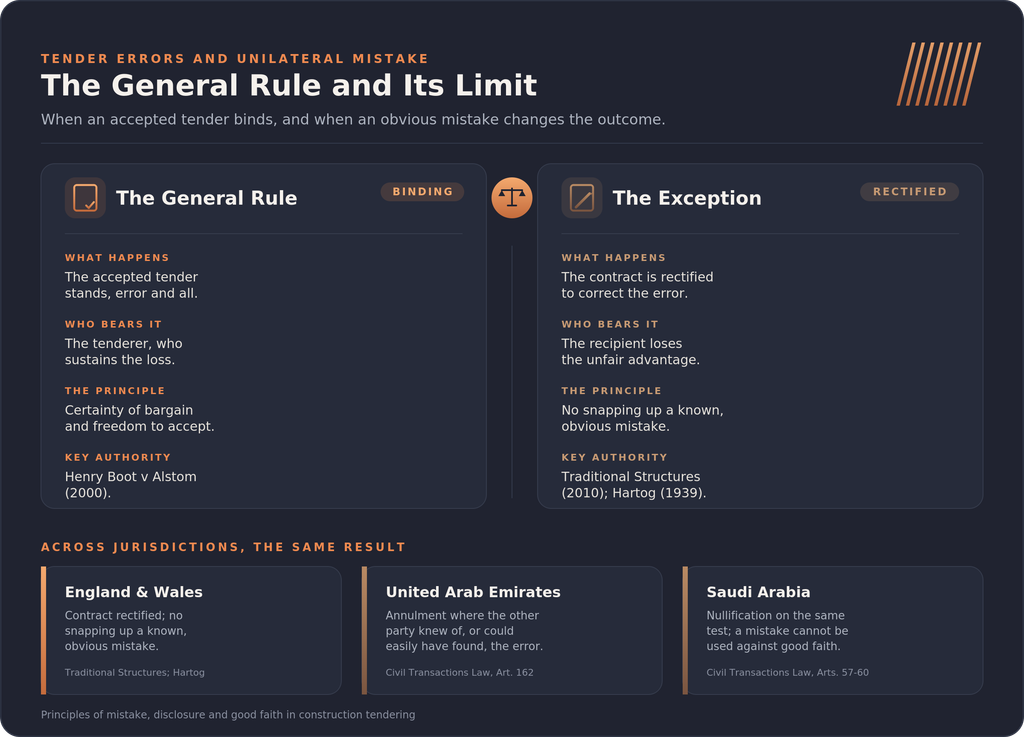
Figure 2: The court’s practical test. Whether the tenderer is bound turns on knowledge and honest conduct, not on the error alone.
The Position in the UAE and Saudi Arabia
The same question is worth examining in the Gulf, where most construction projects are governed by codified civil-law systems. The doctrinal route is different, yet the destination is broadly the same, and in some respects the civil codes protect the mistaken party more readily.
In the United Arab Emirates, the new Civil Transactions Law (Federal Decree-Law No. 25 of 2025), in force since 1 June 2026, addresses the point directly. A party that makes a fundamental mistake may seek annulment of the contract where the other party made the same mistake, knew of it, or could easily have discovered it (Article 162). The law also imposes a pre-contract duty to disclose information of decisive importance to the other party’s consent, and that duty cannot be excluded by agreement (Article 122). Just as significantly, the obligation of good faith, long established for the performance of contracts under the previous code, now extends to the negotiation stage itself. A recipient who spots an obvious tender error, or who could easily have spotted it, and stays silent to secure the price is therefore on weak ground; the mistaken tenderer may be able to unwind the contract.
Saudi Arabia reached a similar position through its first codified Civil Transactions Law (Royal Decree No. M/191), in force since 16 December 2023. A party may seek to nullify a contract for a substantial mistake, but, tellingly, only where the other party made the same mistake, knew of it, or could easily have detected it; a purely one-sided mistake, unknown to the other side, is not enough, and a mere clerical or mathematical slip does not qualify (Articles 57 to 60). The law also requires good faith in negotiation and the sharing of material information (Article 41), treats deliberate silence that induces a contract as a form of deceit, and confirms that a party cannot invoke a mistake in a manner contrary to good faith. The effect mirrors the English outcome: a bargain built on a known, obvious error is not secure.
Two practical points follow for projects in the region. First, the remedy differs. The civil codes speak in terms of annulment or nullification of the contract and compensation, rather than the rectification an English court ordered in Traditional Structures, so the commercial consequences of getting it wrong are not identical. Second, standard international forms such as FIDIC are used widely across the Gulf, but they sit on top of these mandatory code provisions; the good-faith and disclosure duties apply regardless of what the contract says. Specific local-law advice is essential, because the detail, and the remedy available, turns on the governing law of the particular contract.
Harmony’s Perspective
In our experience, disputes of this kind are rarely caused by the estimating error itself. They are caused by how the parties behave once the error is, or should have been, apparent. That behaviour is a contract administration issue, and it is manageable.
- treating tender review as a contract-formation exercise, not simply a price comparison, so apparent inconsistencies are identified before acceptance rather than argued about afterwards;
- raising any suspected error or omission in writing before accepting, particularly where a price looks materially out of line with the scope, the specification, or comparable bids;
- keeping tender records consistent, so that the issued document and the retained file tell the same story if the matter is ever examined;
- confirming scope and the contract sum clearly on acceptance, rather than leaving them to inference, because ambiguity is what later disputes feed on;
- reading tender conduct against the law that actually governs the contract, since the UAE and Saudi civil codes impose good-faith and disclosure duties that can constrain a party earlier, and more readily, than English common law;
- recognising that certainty, not advantage, is the commercially safer position; a bargain built on a mistake the other party has clearly made is seldom a bargain that holds.
Fairness and clarity at tender stage are not soft courtesies. They are the most reliable protection against a contract being reopened later.
Key Takeaways
Before accepting a tender that looks unusually favourable, project teams should be able to answer several questions:
- Is the price consistent with the scope, the specification, and the range of comparable bids received?
- Does anything in the tender or the surrounding correspondence suggest an error, an omitted item, or more than one intended price?
- Would an honest party in the same position raise the point before accepting, rather than stay silent and rely on the mistake?
- If you are the tenderer, does the document you issued match your internal file, and have you confirmed scope in writing?
- Is this a public-sector procurement, where equal-treatment duties and the rules of the tender process govern whether and how a genuine error may be corrected?
Answering these questions before acceptance is far cheaper than resolving them afterwards through rectification or litigation.
Conclusion
The general rule in construction tendering protects certainty: a party that misprices its bid will usually have to live with the result, and an employer is entitled to accept a keen price without policing the tenderer’s arithmetic. That principle gives the industry the commercial stability it needs.
But it is not unlimited. Where an error is obvious and the party receiving the tender knows it, the law will not allow that party to stay silent and take advantage. In those circumstances the courts will step in, rectify the contract, and require a fair price to be paid. Commercial freedom ends where sharp practice begins. This is not a peculiarity of the common law; the civil codes of the UAE and Saudi Arabia reach the same result through their rules on mistake, disclosure, and good faith, and in some respects go further.
For organisations on either side of a tender, the safest course is the same, and it is not complicated. If a price looks too good to be true, the honest and prudent response is to ask, not to accept and hope. The question a court will ultimately consider is less whether a mistake was made, and more how the other party behaved once it saw it.
References
- Traditional Structures Ltd v HW Construction Ltd [2010] EWHC 1530 (TCC). https://caselaw.nationalarchives.gov.uk/ewhc/tcc/2010/1530
- Hartog v Colin & Shields [1939] 3 All ER 566. https://ipsaloquitur.com/contract-law/cases/hartog-v-colin-shields/
- Henry Boot Construction (UK) Ltd v Alstom Combined Cycles Ltd [2000] EWCA Civ 99. https://jusmundi.com/en/document/decision/en-henry-boot-construction-limited-v-gec-alstom-combined-cycles-ltd-judgment-of-the-court-of-appeal-of-england-and-wales-2000-ewca-99-tuesday-4th-april-2000
- United Arab Emirates. Civil Transactions Law (Federal Decree-Law No. 25 of 2025), in force 1 June 2026 (mistake, Article 162; pre-contract disclosure, Article 122; good faith). https://uaelegislation.gov.ae/en/legislations/4011
- Kingdom of Saudi Arabia. Civil Transactions Law (Royal Decree No. M/191 of 1444H), in force 16 December 2023 (mistake, Articles 57 to 60; good-faith negotiation and disclosure, Article 41; good faith, Article 95). https://laws.moj.gov.sa/en/legislation/PBbHmywh1XMp-Kyv3NtQLg