
How Two Distinct Disciplines Combine to Prove Time and Money in Complex Claims
When a major construction dispute reaches arbitration, adjudication, or the courts, the outcome rarely turns on legal argument alone. It turns on evidence, and increasingly on expert evidence. Programmes are dissected, cost records are tested, and two specialists are asked to explain, independently and under scrutiny, what went wrong and what it cost: the delay expert and the quantum expert.
These two roles are frequently confused, and occasionally conflated into one. Parties sometimes assume a single well-qualified consultant can cover both, or that a strong delay analysis will, on its own, secure the money claimed. In practice, delay and quantum are separate disciplines. They rest on different evidence, apply different methods, and answer different questions. A dispute can be won on time and lost on money, or the reverse, precisely because the two were not properly distinguished or properly coordinated.
The question for any party facing a significant claim is therefore not simply “do we need an expert?” but “which expertise does this dispute actually require, and how should the two work together?”
Who Are Delay and Quantum Experts?
Both are independent experts appointed to assist a tribunal. Their overriding duty is to that tribunal, not to the party paying their fee. Beyond that shared foundation, their work diverges sharply.
A delay expert analyses time. Their task is to establish what caused a project to finish late, or to fall behind against its programme, and who bears responsibility for each period of delay. This is the world of the construction programme, the critical path, and recognised delay analysis methodologies such as as-planned versus as-built comparison, time impact analysis, and windows analysis. The delay expert’s opinion typically underpins entitlement to an extension of time, and the allocation of responsibility between employer and contractor for any given period of slippage.
A quantum expert analyses money. Their task is to quantify the financial consequences of the events in dispute: prolongation costs, loss and expense, the value of variations, disruption to productivity, and, where relevant, damages. This is the world of cost records, valuation, and accounting evidence. The quantum expert translates findings about liability and time into a defensible figure.
The distinction is captured well in practice. It is common for each side to appoint its own delay analyst, and equally common for those analysts to disagree, leaving the tribunal to decide whose analysis it prefers. The same pattern plays out on quantum. Neither exercise is an exact science, which is exactly why the discipline, independence, and transparency of the expert matter so much.
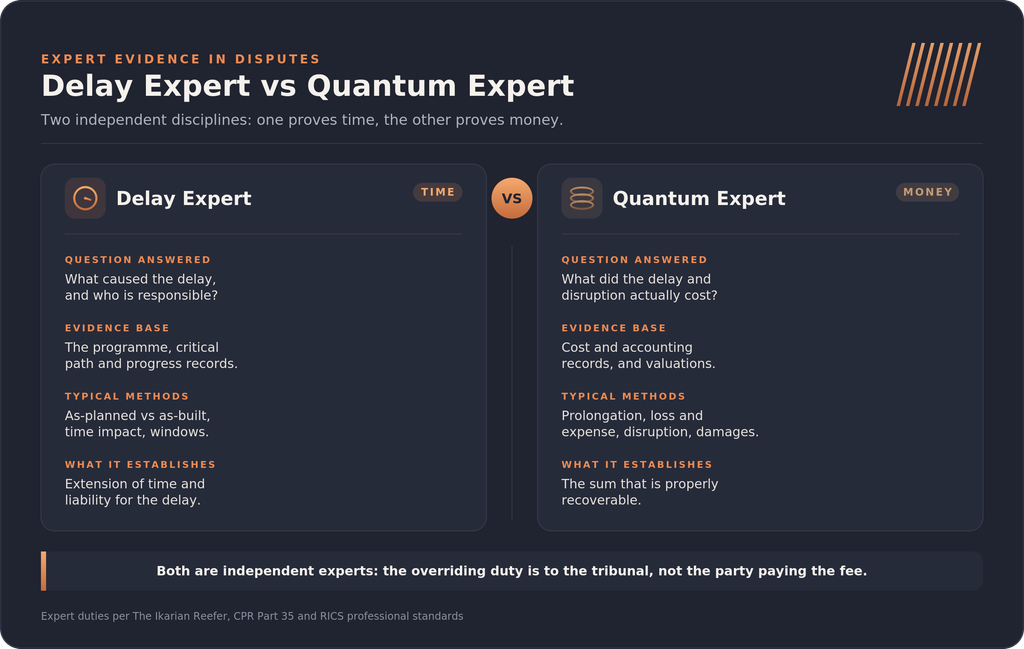
Figure 1: Delay expert versus quantum expert. Two independent disciplines, resting on different evidence and answering different questions.
Why the Distinction Matters
Treating delay and quantum as a single undifferentiated “claims” exercise is one of the more expensive mistakes a party can make.
First, the two answer different questions from different evidence. Delay is proved from programmes and progress records; quantum is proved from cost and accounting records. An outstanding delay analysis says nothing, by itself, about whether the sums claimed are reasonable, properly incurred, or correctly valued.
Second, the two follow a logical sequence. Quantum frequently depends on delay. The value of a prolongation claim, for example, is a function of the compensable delay period that the delay expert establishes. If the delay analysis moves, the quantum moves with it. Appointing the right specialists, in the right order, keeps that chain intact.
Third, independence is the source of credibility. The modern duties of an expert were set out in National Justice Compania Naviera SA v Prudential Assurance Co Ltd (The Ikarian Reefer) and now sit at the heart of civil procedure and professional standards alike: expert evidence must be the independent, objective product of the expert, and an expert should never assume the role of an advocate. An expert who strays outside their field, or who argues the client’s case rather than stating an honest opinion, forfeits the very credibility that makes the evidence worth having.
Fourth, matching the right expertise to the real issue avoids both gaps and overlap. Where the dispute is genuinely about time, a quantum expert cannot fill the gap; where it is about the reasonableness of cost, a delay expert cannot. Understanding which discipline the dispute actually calls for is the first commercial decision, not a technical afterthought.
Where the Risks Begin
Most difficulties in this area do not come from the experts’ technical ability. They come from how, and when, the roles are used.
Conflating the two roles. Asking one person to opine on both time and money, outside their true expertise, invites challenge. Under established duties, an expert must make clear when a question falls outside their competence. A delay analyst offering firm views on the valuation of variations, or a quantum expert opining on critical path logic, weakens the whole case.
Appointing too late. Expert evidence is only as good as the records it rests on. Where experts are engaged long after the events, the delay analysis and the cost narrative must be reconstructed rather than traced through contemporaneous records, and reconstruction is always more vulnerable under cross-examination. Early appointment lets the expert shape what is recorded while it can still be captured.
Experts drifting into advocacy. The “hired gun” who tailors an opinion to the client’s preferred number is a recurring concern in construction disputes, and tribunals are alert to it. Once an expert is seen as partisan, the tribunal discounts the evidence, and sometimes the case with it.
Inconsistent assumptions between the two experts. If the delay expert works to one delay period and the quantum expert prices a different one, or if they adopt different baselines or different factual assumptions, opposing counsel will expose the gap. Delay and quantum evidence must be built on a shared factual foundation.
Methodology disputes. There is no single accepted method of delay analysis, and different methods applied to the same facts can produce very different results. The same is true of disruption valuation, where approaches range from the “measured mile” to assessed-cost methods. The choice of method, and the reasons for it, must be explained and defensible rather than assumed.
Procedural and jurisdictional differences. The framework governing experts is not uniform. In England and Wales, the Civil Procedure Rules impose a strict overriding duty to the court and allow for single joint experts. International arbitration more often relies on party-appointed experts, with instruments such as the CIArb Protocol and the IBA Rules shaping how their evidence is given, including the use of concurrent evidence, sometimes called “hot tubbing.” A strategy that fits litigation in London may need rethinking for an arbitration seated elsewhere.
How the Two Experts Work Together
On a straightforward claim, one discipline may be enough. A pure valuation dispute may need only a quantum expert; a dispute purely about entitlement to time may need only a delay expert. The difficulty is that most significant construction disputes involve both, and the two must be sequenced and coordinated rather than run in parallel silos.
The logical order usually begins with delay. The delay expert establishes the critical delay events, the periods of delay, and the responsibility for each. Those findings then frame the quantum expert’s work: the compensable delay period drives the prolongation valuation, the events found to be compensable define which costs are recoverable, and the disruption established informs the productivity analysis. Run the other way round, or run in isolation, the two analyses tend to diverge on exactly the assumptions a tribunal will scrutinise most closely.
Coordination does not compromise independence. Each expert must still reach their own honest opinion within their own field. What coordination ensures is that the two opinions share a consistent factual basis, so that the party presents a coherent case rather than two technically competent analyses that quietly contradict each other.
This is also where the decision on how many experts, and of what kind, should be made deliberately at the outset, based on the issues genuinely in dispute rather than on habit or on the assumption that more experts always means a stronger case.
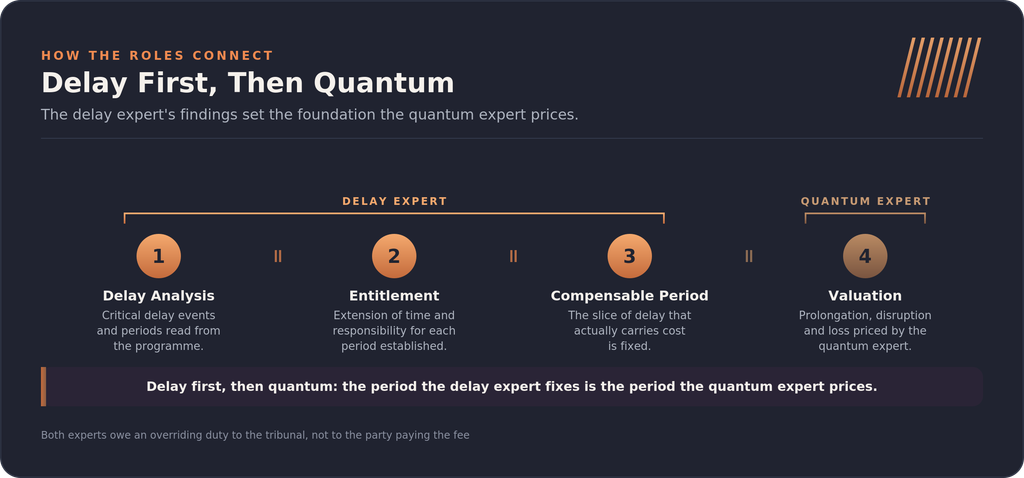
Figure 2: The delay findings set the foundation. The compensable period the delay expert fixes is the period the quantum expert prices.
Harmony’s Perspective
In our experience across international disputes, the strength of an expert case is decided long before a report is exchanged. It is decided by how the roles are scoped, sequenced, and disciplined.
Parties under pressure often reach for a single familiar name, or leave the expert question until proceedings are already under way. By then the records may be incomplete, the delay and quantum positions may have drifted apart, and the opportunity to build a coherent case has narrowed.
Our expert services approach is built to avoid that, and rests on a consistent set of disciplines:
- matching the right expertise to the issues actually in dispute, rather than stretching one generalist across both time and money;
- preserving independence and the overriding duty to the tribunal, whoever pays the fee, because credibility is the expert’s entire value;
- involving experts early, so opinions rest on contemporaneous records and a sound programme rather than on later reconstruction;
- coordinating delay and quantum on shared assumptions, so the compensable delay period drives the prolongation valuation and the two analyses reinforce rather than undermine each other;
- testing methodology rigorously in advance, so the chosen approach can withstand cross-examination rather than collapse under it.
Above all, expert evidence is a matter of professional independence, not partisanship. The most persuasive expert is not the one who argues hardest for the client, but the one whose objectivity the tribunal trusts.
Key Takeaways
Before instructing experts in a construction dispute, project teams and their advisers should consider several fundamental questions:
- Is this dispute really about time, money, or both, and has the right expertise been matched to each?
- Have experts been appointed early enough to work from records made at the time, rather than from reconstruction?
- Do the delay and quantum analyses share the same factual assumptions and the same delay periods?
- Is each expert working strictly within their own field, or is one straying into the other’s territory?
- Would the expert’s evidence read as independent opinion, or as advocacy for the party paying the fee?
- Has the procedural framework, whether the Civil Procedure Rules, arbitral rules, or a single joint appointment, been settled before instructions are issued?
Answering these questions early is what separates a coherent, credible expert case from two competent reports that fail to add up.
Conclusion
The delay expert and the quantum expert are not interchangeable, and neither is optional in a dispute that turns on both time and money. One explains how a project fell behind and who was responsible; the other explains what that delay and disruption actually cost. Their disciplines are distinct, but their conclusions are interdependent.
Success in a construction dispute rarely rests on a single brilliant analysis. It rests on appointing the right expertise for the issues in play, preserving the independence that gives expert evidence its weight, and coordinating time and money so that the two tell one consistent story.
For organisations facing high-value construction disputes, the question is not whether to engage expert evidence, but how to structure it: which experts, in which order, working to which standard of independence and rigour. Getting that structure right is often the difference between a claim that persuades and one that merely asserts.
References
- National Justice Compania Naviera SA v Prudential Assurance Co Ltd (The Ikarian Reefer) [1993] 2 Lloyd’s Rep 68 (Cresswell J). https://swarb.co.uk/national-justice-compania-naviera-s-a-v-prudential-assurance-company-ltd-the-ikarian-reefer-1993/
- Civil Procedure Rules, Part 35: Experts and Assessors (England & Wales). https://www.justice.gov.uk/courts/procedure-rules/civil/rules/part35
- Royal Institution of Chartered Surveyors (RICS). Surveyors Acting as Expert Witnesses (5th ed., 2025; global standard). https://www.rics.org/profession-standards/rics-standards-and-guidance/sector-standards/dispute-resolution-standards/surveyors-acting-as-expert-witnesses
- Chartered Institute of Arbitrators (CIArb). Protocol for the Use of Party-Appointed Expert Witnesses in International Arbitration. https://www.ciarb.org/media/zvijl3kx/7-party-appointed-and-tribunal-appointed-expert-witnesses-in-international-arbitration-2015.pdf
- Society of Construction Law (SCL). Delay and Disruption Protocol (2nd ed., February 2017). https://www.scl.org.uk/resources/delay-disruption-protocol
- International Bar Association (IBA). Rules on the Taking of Evidence in International Arbitration (2020). https://www.ibanet.org/resources