
Why Disciplined Record-Keeping Determines the Outcome of Delay and Disruption Claims

On large, complex projects, claims are no longer the exception; they are a routine feature of delivery. Compressed programmes, evolving designs, interface-heavy engineering, and demanding stakeholder requirements all increase the likelihood that a contractor will, at some point, seek additional time or money. Yet the difference between a claim that succeeds and one that quietly collapses rarely comes down to entitlement in principle. It comes down to evidence.
More than fifty years ago, Max Abrahamson captured the reality that every experienced claims practitioner eventually learns, often too late. The three lessons of any dispute, he wrote, are “the importance of records, the importance of records and the importance of records.” Decades of case law and two editions of the Society of Construction Law’s Delay and Disruption Protocol have done nothing to soften that message. If anything, they have sharpened it.
The question for project leaders is therefore not simply whether an event has caused delay or disruption. It is whether the project can prove, from records made at the time, exactly what happened, when, and with what effect.
What Are Contemporary Records?
Contemporary (or contemporaneous) records are documents created at the same time as, or immediately after, the event or circumstance that gives rise to a claim. This is precisely how the 2017 FIDIC forms define the term in their revised claims procedure, and it mirrors the position taken by the courts.
The distinction matters because it excludes two things project teams often rely on when a dispute crystallises: memory and reconstruction. A schedule of labour hours prepared after the fact, a narrative written months later to explain a delay, or verbal testimony from staff who “remember how it went” are not contemporary records. They are retrospective assessments, and they carry far less weight.
The SCL Protocol groups the records that matter into recognisable categories: programme and progress records, cost and resource records, records of labour and plant, correspondence and instructions, and quality and site records such as diaries, photographs, and inspection reports. Individually, each is a small administrative task. Collectively, they form the evidential spine of any future claim.

Why Contemporary Records Decide Claims
Robust record-keeping does far more than tidy the project file. It is often the single factor that determines entitlement.
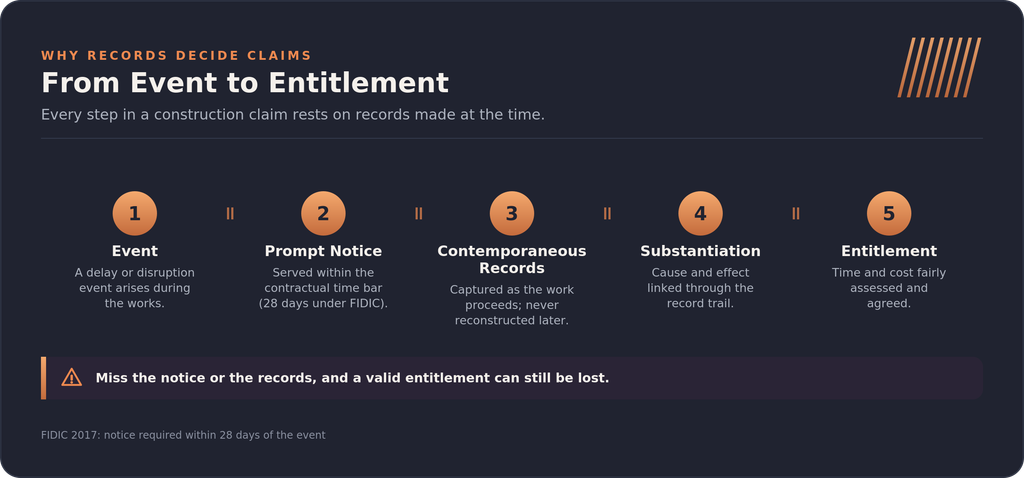
First, contemporary records establish cause and effect. A claim must connect a specific event to a specific consequence in time and cost. Where accurate records exist, that causal link can usually be demonstrated directly, with event, delay, and loss traced through the same paper trail.
Second, good records avoid the weaknesses of global claims. Composite claims that lump many causes together without linking each to its effect are discouraged by the Protocol and rarely welcomed by the courts. A contractor who has maintained complete records seldom needs to resort to a global approach, because the individual threads can be untangled.
Third, records satisfy contractual conditions precedent. Most modern standard forms make timely notice and record-keeping a precondition to recovery. FIDIC requires notice within 28 days of the event; the NEC compensation-event regime works on comparable timescales. Where these requirements operate as conditions precedent, a failure to notify and substantiate on time can extinguish an otherwise valid entitlement altogether.
Fourth, records enable credible delay analysis. Distinguishing employer-risk delay from contractor-risk delay depends on an as-planned programme, an as-built programme, and reliable progress data recorded as the work proceeded. Without that data, forensic analysis becomes speculative, and easy to challenge.
The consequence of getting this wrong is stark. Where there is no contemporary record, the courts have held that the claim will simply fail. Where records exist for part of a claim, that part may succeed while the rest does not. The evidential burden does not move; it sits with the party making the claim.
Where Records Fail
Most record-keeping failures are not the result of bad faith. They are the result of good intentions overtaken by the pace of the project.
The most common problem is reliance on recollection. When a claim is assembled long after the event, teams reach for witness memory to fill the gaps. Courts are consistently reluctant to accept this. In one well-known decision, a claim for management time built on a retrospective assessment was accepted only after the tribunal discounted the hours claimed by twenty per cent, precisely because memory is fallible and may over- or under-state what genuinely occurred.
A second failure is missed notices. A strong factual case is worthless if the contractual gateway has closed. Time-barred claims are among the most avoidable losses in construction, yet they remain common wherever notice discipline is treated as paperwork rather than as a substantive obligation.
Third is the weak or absent baseline programme. A claim for extension of time needs something to measure against. An unrealistic, unapproved, or never-updated programme undermines any analysis built on it, and invites the counter-argument that the delay lay elsewhere.
Fourth is information sprawl. Critical decisions increasingly live in emails, chat messages, and native model files. Without an agreed protocol for capturing and storing this information, key evidence is fragmented across inboxes and lost when personnel move on.
Underlying all of these is a cultural failure: treating records as something to be assembled after a dispute arises, rather than maintained before anyone knows a dispute is coming.
What a Robust Records Regime Looks Like
Effective record-keeping is not about generating more paper. It is about capturing the right information, consistently, from the outset.
A well-run project agrees its records regime before work begins, covering:
- an accepted baseline programme, updated to reflect actual progress, changes in logic, sequence, and any extensions granted;
- cost and resource records reconciled to programme activities;
- daily labour and plant allocations captured at site level;
- a disciplined system for notices, instructions, and correspondence;
- structured management of emails and native files, agreed as a protocol at the start;
- site diaries, progress photographs, and inspection records logged as routine.
Crucially, the regime should be a shared discipline. The Protocol recommends that, where practicable, records be agreed, and ideally signed, by representatives of both employer and contractor, so that the facts are not in dispute even where entitlement is. Records agreed contemporaneously remove an entire category of argument from any later claim.
Harmony’s Perspective
In our experience, the strength of a claim, or the strength of a defence against one, is largely fixed long before the claim is ever articulated. It is determined by contract administration.
Clients and contractors alike tend to focus their energy on the moment of dispute, when leverage and legal argument come to the fore. Yet by then the evidential position is already set. The project either kept the records or it did not.
Our contract administration approach is built on that reality. We establish the record-keeping regime at the outset, so that the type, format, and ownership of records are agreed rather than improvised. We assess time and cost impacts as events occur, rather than adopting a “wait and see” approach that the Protocol now expressly discourages. We maintain and update the baseline programme as a live management tool, not a tender-stage artefact. And we hold notice and substantiation discipline to a contractual standard, because a right that is not exercised in time is, in practice, a right that has been lost.
Equally important is independence. Contemporaneous records support both parties; they are as valuable in resisting an unmeritorious claim as in advancing a sound one. Sound record-keeping is not adversarial positioning; it is professional project governance.
Key Takeaways
Before a project is exposed to its first significant event, project teams should be able to answer the following questions with confidence:
- Has a record-keeping regime been agreed, and does every party understand its role in maintaining it?
- Is there an accepted baseline programme, and is it being updated to reflect actual progress?
- Are notice obligations being treated as substantive contractual conditions, not administrative formalities?
- Can the project trace cause and effect from records made at the time, rather than from later reconstruction?
- Are cost, labour, plant, correspondence, and progress records being captured consistently and stored where they can be retrieved?
- If a dispute arose tomorrow, would the project’s records prove what happened, or merely assert it?
Answering these questions early is far cheaper, and far more effective, than answering them under cross-examination.
Conclusion
Contemporary records are not administrative overhead. They are the foundation on which every successful construction claim, and every successful defence, is built. Entitlement may exist in principle, but it is realised only through evidence, and evidence created after the fact rarely carries the weight of evidence created at the time.
The trend across international practice, from the FIDIC 2017 forms to the second edition of the SCL Protocol, points firmly in one direction: prompt notification, contemporaneous assessment, and disciplined records, applied consistently from the start of the project rather than assembled in its final, disputed weeks.
For organisations delivering increasingly complex construction projects, the lesson is straightforward, if easily forgotten. Claims are not won in the boardroom or the tribunal. They are won, or lost, in the day-to-day discipline of the site office, long before anyone imagines a dispute could arise.
References
- Society of Construction Law (SCL). Delay and Disruption Protocol (2nd ed., February 2017). https://www.scl.org.uk/resources/delay-disruption-protocol
- FIDIC. Conditions of Contract for Construction (Red Book, 2nd ed., 2017), Sub-Clause 20.2, Claims and Contemporary Records. https://fidic.org/bookshop
- FIDIC. FIDIC Contracts Guide (2nd ed., 2022). https://fidic.org/bookshop
- Royal Institution of Chartered Surveyors (RICS). Extensions of Time and Delay Analysis: RICS Guidance Note. https://www.rics.org/profession-standards/rics-standards-and-guidance
- Chartered Institute of Building (CIOB). Guide to Good Practice in the Management of Time in Major Projects. https://www.ciob.org
- NEC. NEC4 Engineering and Construction Contract, Compensation Event Procedures. https://www.neccontract.com