Managing the Legal Grey Zone Between Negotiation and Commitment

In today’s construction industry, projects rarely wait for paperwork to catch up. Clients want design work started, contractors want procurement underway, and programmes are agreed before every commercial term has been finalised. Letters of intent, early instructions to proceed, and correspondence marked “subject to contract” have become routine tools for keeping projects moving during negotiation.
The trouble is that these tools are frequently misunderstood. Parties assume that because an agreement is headed “subject to contract,” or because a formal contract has not yet been signed, no binding obligations exist. In practice, courts and tribunals look well beyond the label. Conduct, correspondence, and partial performance can all create a binding contract long before anyone intended one to exist — or, just as damagingly, leave a party without the protection it believed it had.
The question every project team should be asking is no longer simply “have we signed the contract?” but “at what point, exactly, did we become bound?”
What Does “Subject to Contract” Actually Mean?
Under English law and most common law systems, a binding contract requires offer, acceptance, consideration, and an intention to create legal relations. “Subject to contract” is a well-established device for signalling that this intention is absent — that the parties intend to be bound only once a formal contract is executed, however far negotiations have progressed.
The label is a strong indicator of the parties’ intentions, but it is not conclusive. Its effect can be displaced by subsequent conduct, particularly where one party starts work, is paid for it, or otherwise acts as though a contract is already in place.
This was the central issue in RTS Flexible Systems Ltd v Molkerei Alois Müller GmbH & Co KG [2010] UKSC 14. Müller issued a letter of intent “subject to contract,” work began, the letter expired, and the parties kept negotiating and performing without ever signing a final agreement. The UK Supreme Court nonetheless found a binding contract on the terms by then agreed, holding that it is wrong to assume “subject to contract” terms will never bind — it always depends on the circumstances, viewed objectively. The same principle was applied earlier in Pagnan SpA v Feed Products Ltd [1987] 2 Lloyd’s Rep 601, where the Court of Appeal held that parties are “the masters of their contractual fate” and may choose to be bound even while some terms remain outstanding.
The practical lesson is straightforward but frequently ignored: a heading is not a safeguard. What matters is what the parties actually did.
Why “Subject to Contract” Still Matters
Used correctly, the label remains one of the most effective tools available to protect a party during negotiation. It:
- preserves negotiating flexibility, allowing both sides to explore positions and exchange numbers without being locked into an incomplete or unfavourable position;
- protects against premature commitment, since programme, price, scope, risk allocation, and liability need to be settled as a package rather than becoming binding piecemeal;
- creates an evidential record that, if a dispute later arises, helps demonstrate the parties intended to be bound only on execution of the final agreement;
- supports commercial leverage, since retaining the option to walk away until signature is often what keeps negotiations honest on price and risk.
None of these benefits is automatic. They depend entirely on how consistently the label is used and how carefully conduct is managed alongside it.
Where the Risks Begin
The risks in this area rarely come from the label itself — they come from what happens after it is used, or from situations where it was never used at all.
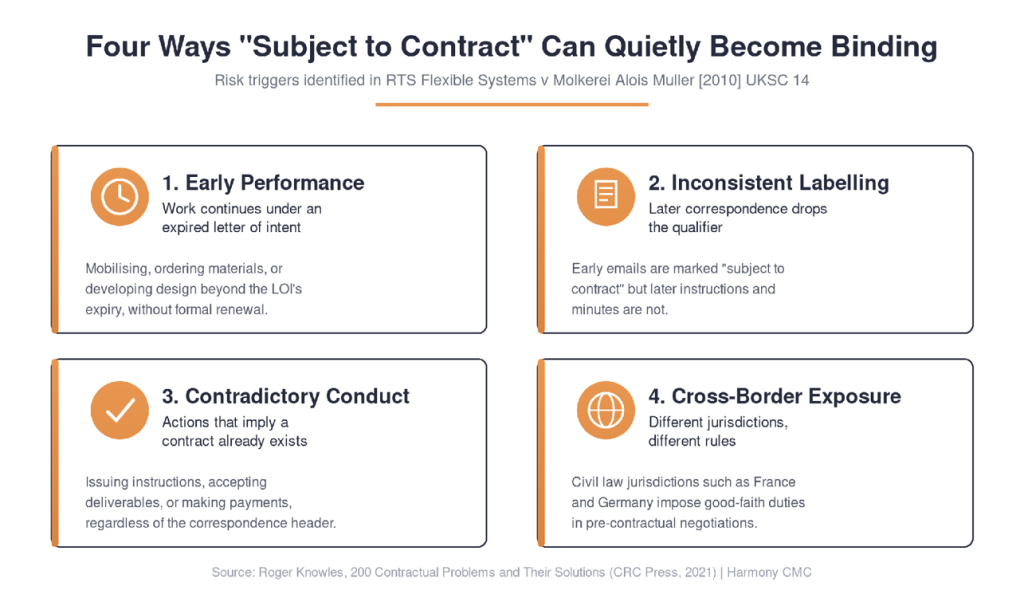
- Early performance under a letter of intent. Contractors are often instructed to mobilise or begin design work before the main contract is signed. If work continues well beyond the LOI’s expiry without formal renewal, courts may find a binding contract has formed regardless of intent — as RTS illustrates.
- Inconsistent labelling. If early correspondence is marked “subject to contract” but later emails and instructions are not, a party may struggle to show the qualification was maintained throughout.
- Conduct that contradicts the label. Issuing instructions, accepting deliverables, or making payments can all be read as evidence of an intention to be bound, whatever the correspondence header says.
- Jurisdictional inconsistency on international projects. Many civil law jurisdictions, including France and Germany, impose good-faith duties in pre-contractual negotiations. “Subject to contract” carries no fixed, universal meaning, and a protection reliable in London may offer far less certainty in Paris or Frankfurt.
Where work has been performed but no contract is found to exist, the usual fallback is a quantum meruit claim for a reasonable sum — assessed without the price, programme, and risk allocation the parties thought they had agreed. Neither party is well served by ending up there.
When Do Negotiations Actually Become Binding?
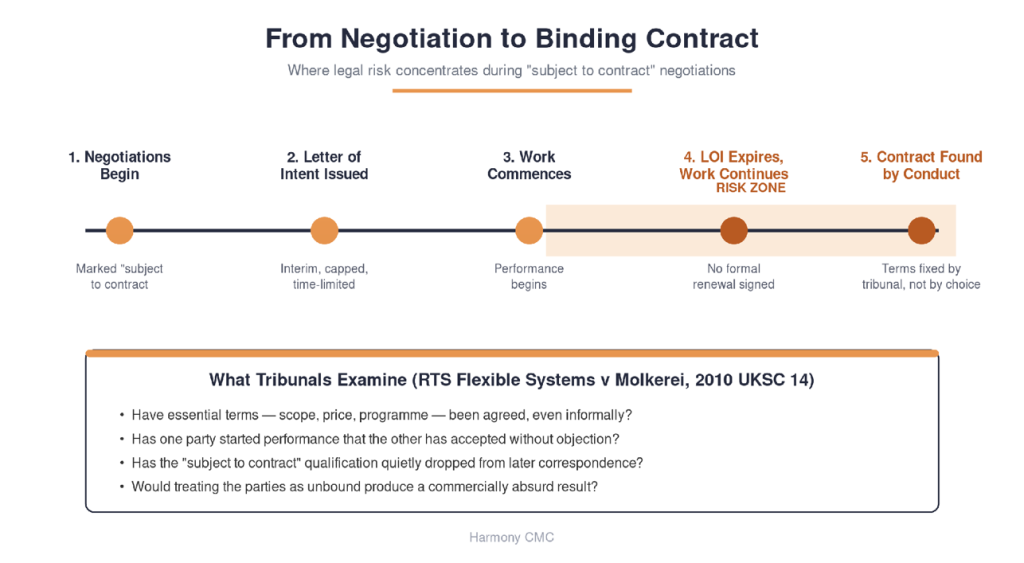
There is no single test, but tribunals consistently examine the same factors: whether essential terms have been agreed even informally, whether one party has started performance that the other has accepted, whether an LOI has expired with work continuing regardless, whether the “subject to contract” qualification has quietly dropped from later correspondence, and whether treating the parties as unbound would produce a commercially absurd result.
None of these factors is decisive alone. Together, they explain why so many construction disputes turn not on what the contract says, but on whether a contract existed at all.
Harmony’s Perspective
In our experience, disputes over contract formation are rarely the result of bad faith — they result from commercial pressure to keep the project moving outpacing legal discipline. Once work starts under a letter of intent, attention shifts to programme and delivery, and the contractual position is often left unresolved for far longer than anyone intended.
A well-managed negotiation should apply the same governance discipline as any other project stage:
- consistent labelling of all negotiation correspondence, without exception;
- clearly scoped, capped, and time-limited letters of intent, renewed formally rather than left to lapse;
- defined triggers for legal review before any instruction to proceed is issued;
- a single, maintained record of what has and has not been agreed;
- explicit confirmation of governing law and jurisdiction on cross-border projects.
Commercial urgency will always create pressure to start early. That pressure should be managed through disciplined use of letters of intent and legal sign-off — not through an assumption that “subject to contract” will hold regardless of how the parties actually behave.
Key Takeaways
Before instructing work to begin ahead of contract execution, project teams should consider:
- Is every piece of negotiation correspondence consistently marked “subject to contract”?
- Does the letter of intent in use have a clear expiry, scope, and liability cap, renewed formally rather than left to lapse?
- Does the team’s conduct match its stated legal position, or is work advancing faster than the paperwork?
- Has governing law and jurisdiction been confirmed, particularly where pre-contractual good-faith duties may apply?
- Would an independent observer, looking only at what the parties actually did, conclude a contract already existed?
Conclusion
“Subject to contract” remains one of the most valuable tools for managing risk during construction negotiations. But it is a tool, not a guarantee — its protection depends entirely on how consistently it is applied and how closely conduct matches stated intent.
References
- RTS Flexible Systems Ltd v Molkerei Alois Müller GmbH & Co KG [2010] UKSC 14. https://www.supremecourt.uk/cases/uksc-2009-0154.html
- Pagnan SpA v Feed Products Ltd [1987] 2 Lloyd’s Rep 601 (Court of Appeal). https://www.bailii.org/ew/cases/EWCA/Civ/1987/12.html
- Royal Institution of Chartered Surveyors (RICS). Letters of Intent, RICS Guidance Note. https://www.rics.org/profession-standards/rics-standards-and-guidance/sector-standards/construction-standards
- Joint Contracts Tribunal (JCT). Guidance Note: Letters of Intent. https://www.jctltd.co.uk/
- FIDIC. FIDIC Procurement Procedures Guide (1st ed., 2011). https://fidic.org/books/fidic-procurement-procedures-guide-1st-ed-2011
- Chartered Institute of Building (CIOB). Code of Practice for Project Management for the Built Environment (6th ed.). https://www.ciob.org/news/new-edition-of-the-code-of-practice-for-project-management-for-construction-professionals-out-now