
Getting the Brief Right Before You Go to Market

In Design & Build (D&B) procurement, the Employer’s Requirements (ERs) are far more than a technical appendix. They define the project brief, establish the performance baseline, and shape the project’s risk profile from day one.
Well-drafted ERs enable genuine single-point responsibility, cost certainty and programme efficiency. Poorly drafted ERs undermine risk transfer, trigger variation claims and generate avoidable disputes.
In our advisory and dispute resolution work across complex building and infrastructure projects, misaligned or underdeveloped ERs are a recurring root cause of cost escalation and programme delay.
Employer’s Requirements and the Procurement Triangle
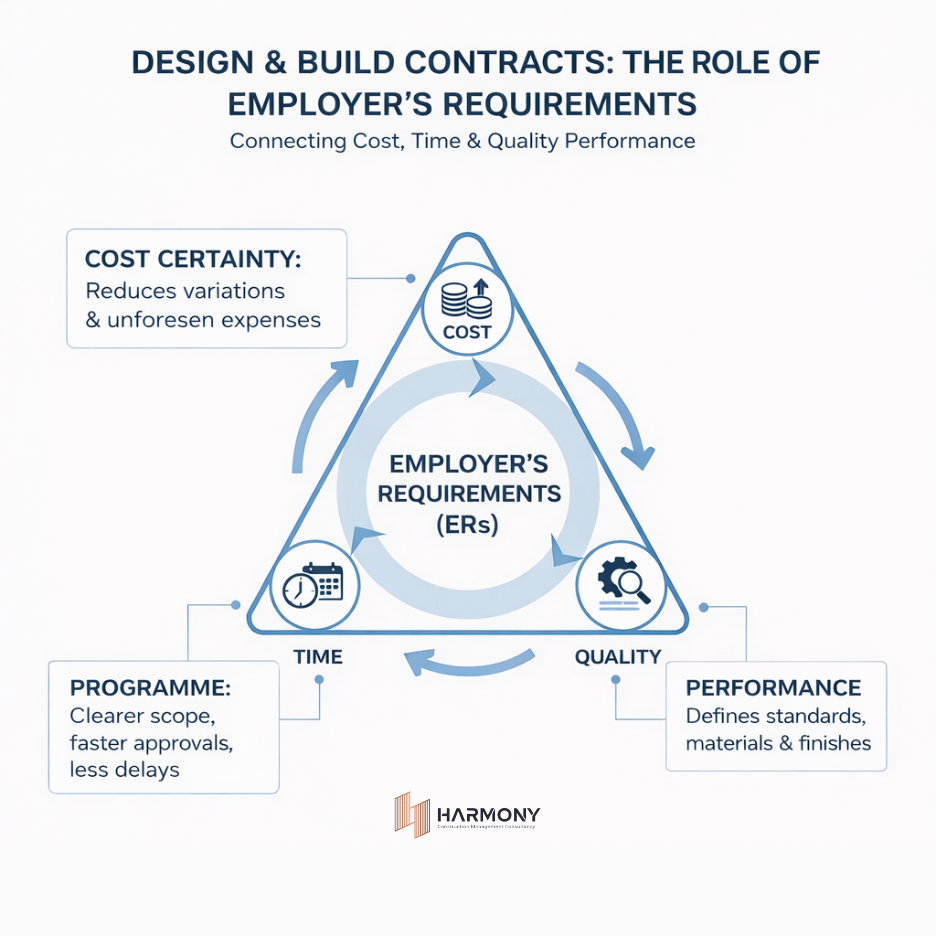
Design & Build procurement aims to balance cost, time and quality. ERs sit at the centre of this triangle.
They:
- Establish the performance benchmark against which tenders are priced
- Define programme drivers such as phasing, approvals and commissioning
- Provide the quality and compliance framework for design responsibility
Without clear ERs, risk is not transferred — it is simply deferred.
Under FIDIC (Yellow and Silver Books) and JCT Design & Build, ERs should define what is required — scope, performance criteria, statutory compliance and key constraints — while allowing contractors appropriate flexibility in how those requirements are achieved.
If ERs are too thin, contractors price assumptions.
If they are too prescriptive, design liability shifts back to the employer.
Both scenarios increase dispute risk.
Six Common Pitfalls in Employer’s Requirements
1. Vague Objectives and Under-Specification
Some ERs read like aspirational statements rather than enforceable contractual documents. Terms such as “high quality” or “future-proof design” appear frequently, yet without measurable performance criteria, such wording invites interpretation disputes.
If performance standards, testing regimes and functional requirements are not clearly defined at tender stage, they are often argued — and paid for — later.
2. Over-Specification and Design Creep
At the opposite extreme, ERs sometimes include near-complete design solutions despite the contractor carrying design responsibility.
This restricts innovation and blurs accountability for design errors embedded within the ERs. In dispute scenarios, the question becomes: who owns the design risk?
Clear delineation is essential.
3. Copy-Paste Drafting and Internal Inconsistencies
Reusing ERs from previous projects without structured review often imports obsolete standards, irrelevant systems or conflicting assumptions.
Discrepancies between drawings, schedules and narrative specifications are a common source of variation claims.
ERs must be reviewed holistically alongside contract conditions.
4. Misaligned Risk Assumptions
Risk allocation belongs in the contract conditions — not in informal assumptions embedded in technical wording.
Assumptions regarding ground conditions, utilities, existing structures or third-party approvals must align with the formal risk strategy.
If they do not, employers may unintentionally retain exposure they intended to transfer.
5. Weak Treatment of Statutory and Lifecycle Requirements
Compliance obligations are often referenced generically, yet performance expectations must be explicit.
Common weaknesses include under-specification of:
- Fire and life-safety requirements
- Acoustic and energy performance
- Maintenance access
- Digital asset information and lifecycle deliverables
Where lifecycle expectations are unclear, long-term asset value is compromised.
6. Insufficient Time and Specialist Input
Preparing robust ERs requires coordinated technical, commercial and operational input.
When ERs are assembled under procurement pressure, gaps appear at discipline interfaces and unrealistic testing or approval regimes emerge.
Upfront investment in structured ER development significantly reduces downstream claims exposure.
A Practical Checklist for Stronger Employer’s Requirements
Before going to market, clients should systematically test their ERs against the following principles:

1. Define Purpose & Performance
Clearly articulate the asset’s function and measurable performance outcomes.
2. Be Clear and Concise
Avoid aspirational language. Specify standards, testing criteria and deliverables precisely.
3. Avoid Hidden Design Liability
Limit prescriptive detail and clearly identify employer-retained design elements.
4. Check Consistency
Review ERs, drawings and contract conditions together to eliminate contradictions.
5. Control Change During Tender
Track clarifications and issue a consolidated, version-controlled ER package before contract signature.
6. Close the Loop with Contractor’s Proposals
Confirm accepted proposals demonstrably satisfy each requirement — or document deviations transparently.
Conclusion: Employer’s Requirements as a Strategic Risk Tool
Employer’s Requirements are not simply procurement documentation. They are a strategic risk management instrument.
Done well, they enable Design & Build to deliver predictable cost outcomes, programme certainty and clear accountability.
Done poorly, they defer difficult decisions to construction — where resolution becomes significantly more expensive and contentious.
For clients pursuing complex infrastructure and building projects, investing in structured, performance-driven ERs remains one of the most effective steps toward commercial certainty and dispute avoidance.
References
- FIDIC (2017). Conditions of Contract for Plant and Design-Build (Yellow Book) and EPC/Turnkey Projects (Silver Book).
International Federation of Consulting Engineers (FIDIC).
https://fidic.org/books/conditions-contract-plant-and-design-build-yellow-book
https://fidic.org/books/conditions-contract-epcturnkey-projects-silver-book - JCT (2016 / 2024 Editions). Design and Build Contract.
The Joint Contracts Tribunal.
https://www.jctltd.co.uk/category/design-and-build - RICS (Royal Institution of Chartered Surveyors). Guidance Note: Employer’s Agent Under Design and Build Contracts.
https://www.rics.org/uk/upholding-professional-standards/sector-standards/construction/employers-agent-under-design-and-build-contracts - RICS (2017). Global Professional Statement: Risk, Liability and Insurance in Construction.
https://www.rics.org/uk/upholding-professional-standards/sector-standards/construction/risk-liability-and-insurance-in-construction - UK Cabinet Office (2019). The Construction Playbook.
Guidance on procurement strategy, risk allocation and specification clarity.
https://www.gov.uk/government/publications/the-construction-playbook - ICE (Institution of Civil Engineers). Managing Risk in Construction Projects.
https://www.ice.org.uk/knowledge-and-resources - Society of Construction Law (SCL). Delay and Disruption Protocol (2nd Edition).
https://www.scl.org.uk/resources/delay-and-disruption-protocol