
Strategies and Procedures for Effective Claims Management Under the New FIDIC Framework

The release of the FIDIC 2017 suite marked a watershed moment in international construction contracting. Among the most significant revisions, Clause 20 underwent a fundamental transformation that has reshaped how both Contractors and Employers manage claims. For decision-makers, project managers, and civil engineers working on major construction projects, understanding these changes is essential for protecting your organization’s interests and ensuring project success.
The 2017 edition addresses long-standing criticisms about procedural imbalance and unclear requirements, introducing a more rigorous yet fairer claims management system. This article examines the critical changes to Clause 20 and provides practical guidance for navigating this new landscape.
The Fundamental Restructuring: Claims and Disputes Separated
One of the most significant structural changes in FIDIC 2017 is the separation of claims from disputes. In the 1999 editions, Clause 20 was titled “Claims, Disputes and Arbitration” and combined all these procedures in a single clause. The 2017 edition divides this into two distinct clauses: Clause 20 (Employer’s and Contractor’s Claims) and Clause 21 (Disputes and Arbitration). This separation reflects FIDIC’s recognition that a claim is fundamentally different from a dispute. A claim is simply a request for an entitlement under the contract—it only becomes a dispute if rejected or ignored. By separating these concepts, FIDIC 2017 emphasizes that claims are a normal part of contract administration, not inherently adversarial proceedings.
Equal Treatment: Employers Now Subject to the Same Rule
Perhaps the most transformative change in Clause 20 is the requirement that both Employer and Contractor claims follow the same procedure. Under the 1999 Red Book, Contractor claims were governed by Sub-Clause 20.1, while Employer claims fell under Sub-Clause 2.5—with notably different requirements. The Contractor faced a strict 28-day notice requirement with severe consequences for non-compliance, while the Employer was merely required to give notice “as soon as practicable” with no specified time limit.
The 2017 edition eliminates this asymmetry. Now, both parties must submit a Notice of Claim within 28 days of becoming aware of the event giving rise to the claim. Both parties must also submit a fully detailed claim within 84 days, and both face the same consequences for non-compliance. This represents a significant leveling of the playing field and demands that Employers establish robust claim management systems—a requirement that was previously more pressing only for Contractors.
FIDIC 1999 vs 2017: Key Changes at a Glance
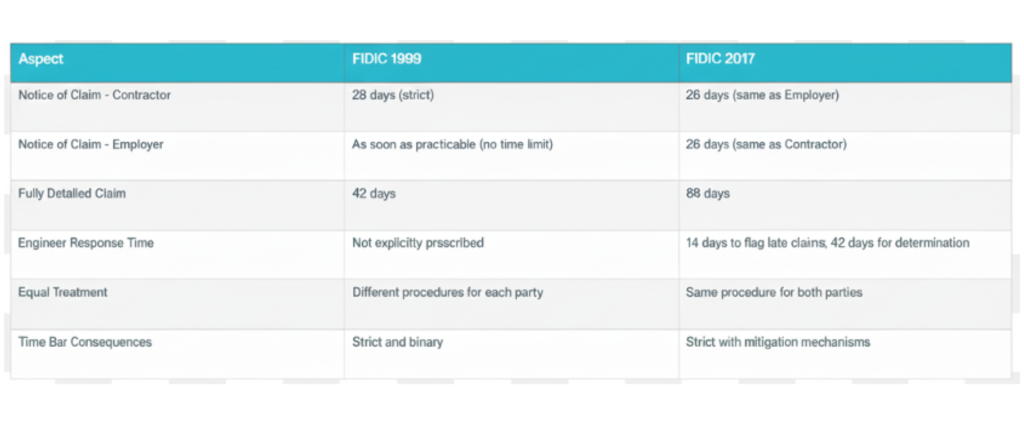
The above comparison clearly illustrates how the 2017 edition addresses the procedural imbalances of its predecessor. The most striking change is the equal 28-day notice requirement for both parties and the extension to 84 days for fully detailed claims—giving parties more time to build comprehensive submissions. Additionally, the introduction of explicit Engineer response timelines (14 days and 42 days) brings much-needed clarity to the determination process.
The Enhanced Claims Procedure
The claims procedure in FIDIC 2017 is significantly more detailed than its 1999 predecessor, introducing new time limits, content requirements, and safeguards.
Notice of Claim (Sub-Clause 20.2.1): The claiming Party must give a Notice of Claim to the Engineer as soon as practicable and no later than 28 days after becoming aware of the event or circumstance giving rise to the claim. This notice must contain a written description of the event and be expressly identified as a Notice. Failure to meet this deadline results in discharge from any liability in connection with the event.
Engineer’s Initial Response (Sub-Clause 20.2.2): FIDIC 2017 introduces a new safeguard. If the Engineer considers that the Notice of Claim was submitted late, the Engineer must give notice within 14 days, stating the reasons. Critically, if the Engineer fails to respond within 14 days, the Notice of Claim is deemed valid. This places significant responsibility on the Engineer and protects the claiming Party against losing its rights through the Engineer’s inaction.
Contemporary Records (Sub-Clause 20.2.3): Contemporary records are now defined as “records that are prepared or generated at the same time, or immediately after, the event or circumstance giving rise to the Claim.” This definition resolves ambiguity from the 1999 edition about what constitutes acceptable documentation.
Fully Detailed Claim (Sub-Clause 20.2.4): The 2017 edition extends the time for submitting a fully detailed claim from 42 days to 84 days, reflecting the reality that substantiating complex claims requires considerable effort. A fully detailed claim must include: (1) a detailed description of the event or circumstance, (2) a statement of the contractual and/or legal basis, (3) all contemporary records relied upon, and (4) detailed supporting particulars of the amount claimed and/or extension of time sought. Failure to provide the contractual basis within 84 days results in the Notice of Claim being deemed to have lapsed—a new time-bar that did not exist in 1999.
Engineer’s Determination (Sub-Clauses 20.2.5 and 3.7): The Engineer must consult with both parties in an endeavor to reach agreement. If no agreement is reached, the Engineer must make a fair determination within 42 days of receiving the fully detailed claim, acting neutrally between the parties. If the Engineer fails to issue a determination within the prescribed time, the Engineer is deemed to have rejected the claim.
FIDIC 2017 Enhanced Claims Procedure Timeline
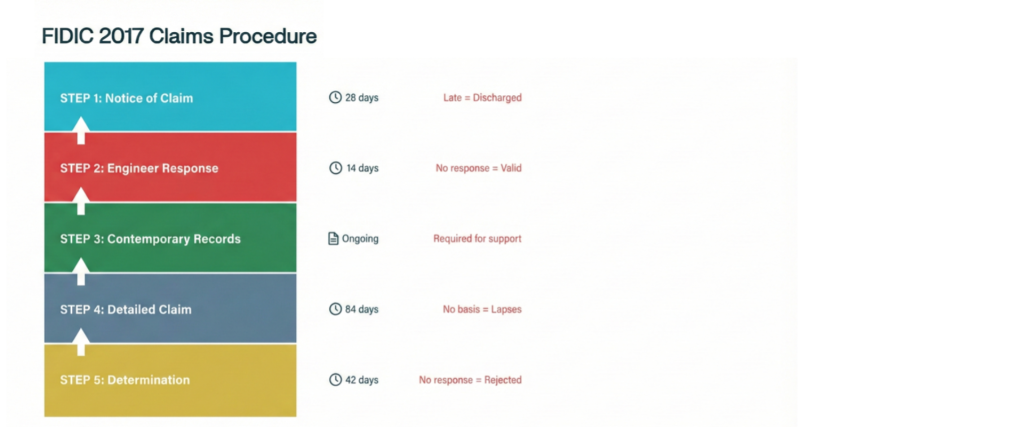
The timeline above maps the complete five-step claims process, showing how each stage connects to the next and the critical time limits at each juncture. Understanding this sequence is fundamental to ensuring compliance and protecting your organization’s claim rights. The most important takeaway is that missing any single deadline—from the initial 28-day notice through to the Engineer’s 42-day determination window—can result in partial or complete loss of your claim.
The DAAB: From Reactive to Proactive Dispute Resolution
The 2017 edition transforms the Dispute Adjudication Board (DAB) into a Dispute Avoidance/Adjudication Board (DAAB), reflecting a philosophical shift from resolving disputes to preventing them. The DAAB is now a standing body appointed at the outset of the project rather than an ad-hoc mechanism convened only when disputes arise. By remaining engaged throughout the project lifecycle, the DAAB can identify and address issues early, promoting a collaborative, problem-solving approach that prevents disputes before they escalate into formal claims.
Practical Guidance for Success
For Contractors: Establish robust early warning systems to identify claim events promptly. Implement strict internal procedures to ensure 28-day notice deadlines are never missed. Develop documentation systems capable of generating contemporary records in real-time. Allocate resources for preparing fully detailed claims within the 84-day window.
For Employers: Recognize that the same procedural requirements now apply to Employer claims. Train commercial teams on the new notice obligations. Ensure the Engineer understands their enhanced responsibilities and strict time limits. Budget appropriately for DAAB standing costs from project inception.
For Engineers: Understand your significant new responsibilities for monitoring, responding, and determining claims. Maintain strict diary systems for the multiple 14-day and 42-day response deadlines. Recognize the neutrality obligation when making determinations.
Conclusion: A More Balanced but More Demanding Framework
FIDIC 2017’s Clause 20 represents a significant evolution in construction claims management. The changes create a more balanced framework that subjects both Employers and Contractors to equivalent obligations and consequences. However, this balance comes with increased complexity and administrative burden. Both parties must invest in proper contract administration systems, train their teams thoroughly, and maintain vigilant compliance with the multiple deadlines and notice requirements. The consequences of non-compliance remain severe—even valid claims can be lost through procedural failures.
For organizations working on international construction projects, understanding and implementing these changes is not merely good practice—it is fundamental to protecting contractual entitlements and managing project risk effectively. The firms that master these requirements will find themselves with a significant competitive advantage. At our consultancy, we have witnessed firsthand how proper understanding and implementation of FIDIC 2017’s claims provisions transforms potential project obstacles into manageable business processes. Our extensive experience bridges the gap between contractual requirements and on-the-ground realities, helping clients navigate these complexities and achieve sustainable project success through proactive, expert-guided contract management.
References
- Changes to the Claims provisions in the 2017 FIDIC Red Book. Fenwick Elliott. https://www.fenwickelliott.com/research-insight/newsletters/international-quarterly/changes-claim-provisions-2017-fidic-red-book
- FIDIC 1999 vs 2017: Key Changes in Construction Contracts. TC Cons. https://tccons.ae/blog/fidic-1999-vs-fidic-2017-key-changes-and-their-implications-for-construction-projects/
- Claims Process – Clause 20 – FIDIC 2017. LinkedIn. https://www.linkedin.com/pulse/claims-process-clause-20-fidic-2017-adine-abro-1
- FIDIC 2017: Clause 20 – Employer’s and Contractor’s Claims. International Construction Knowledge Hub. https://internationalconstructionknowledgehub.com/wp-content/uploads/GMC-FIDIC-2017-Clause-20-Employers-and-Contractors-Claims.pdf
- What are the differences between FIDIC 1999 and 2017 claims resolution procedures. Contract Bites. https://contractbites.com/what-are-the-differences-between-fidic-1999-and-2017-claims-resolution-procedures/
- The claims process under FIDIC 2017. Diales. https://www.diales.com/en/news/the-claims-process-under-fidic-2017-from-a-contractor-s-perspective
- Dispute avoidance and adjudication board under the new FIDIC contract conditions (2017). Codozasady. https://codozasady.pl/en/p/dispute-avoidance-and-adjudication-board-under-the-new-fidic-contract-conditions-2017
- The time bar discretion in FIDIC 2017. Systech International. https://www.systech-int.com/insights/thoughts/the-time-bar-discretion-in-fidic-2017-raising-the-jocelyne
- Determination in Sub-Clause 3.7 of FIDIC 2017 YB and RB. AFITAC. https://afitac.com/2019/11/14/determination-sub-clause-3-7-fidic-2017/
- The role of the Engineer in FIDIC 2017 contracts. Fenwick Elliott. https://www.fenwickelliott.com/sites/default/files/the_role_of_the_engineer_in_fidic_contracts_-_fenwick_elliott.pdf