
Strategies, Procedures, and Insights for Effective Construction Claim Management

In the world of international construction, claims aren’t a sign of failure—they’re an inevitable part of the process. For projects governed by FIDIC contracts, understanding how to manage claims isn’t just about recovering costs; it’s a strategic skill that protects a project’s timeline and budget. The latest FIDIC editions, especially the 2017 suite, have shifted the focus from resolving disputes to avoiding them in the first place, fundamentally changing how project teams approach contractual relationships and risk.
This guide simplifies the FIDIC claims management process, offering a strategic framework for project success.
The Foundation: Understanding the FIDIC Framework
Under FIDIC contracts, a claim is any request for an entitlement—be it for more time, additional payment, or other relief. The framework’s true power lies in its structured approach, which ensures clear communication and provides a path forward, even when disagreements arise.
The most critical aspect of this framework is procedural compliance. FIDIC contracts treat procedural requirements as a prerequisite for a claim’s success. This means that even a valid claim can fail if you don’t follow the correct steps, with time bar violations being a common pitfall. A prime example is the 28-day notice requirement under Sub-Clause 20.1, a strict deadline that demands prompt action from the contractor.
The Claims Management Process
1. The Initial Notice: Your First and Most Crucial Step
The initial Notice of Claim is the cornerstone of the entire process. It doesn’t need to be a fully detailed document; its purpose is simply to inform the other party of the event giving rise to the claim and to preserve your rights. This notice must be submitted within 28 days of becoming aware of the event. To be effective, it should briefly describe the situation and refer to the relevant contract clauses, ensuring it’s comprehensive enough without being delayed past the critical deadline.
2. The Detailed Submission: Building Your Case
After the initial notice, you must submit a fully detailed claim. The 2017 FIDIC contracts allow 84 days for this, a more flexible timeframe than previous editions. This submission is where you build your case. It must include:
- The contractual and legal basis for your claim.
- All supporting documentation, such as daily reports, progress photos, and correspondence.
- A clear quantification of the time and cost impacts.
The success of your claim hinges on the quality of this submission. A well-supported claim with contemporary records and clear cause-and-effect analysis is far more likely to succeed.
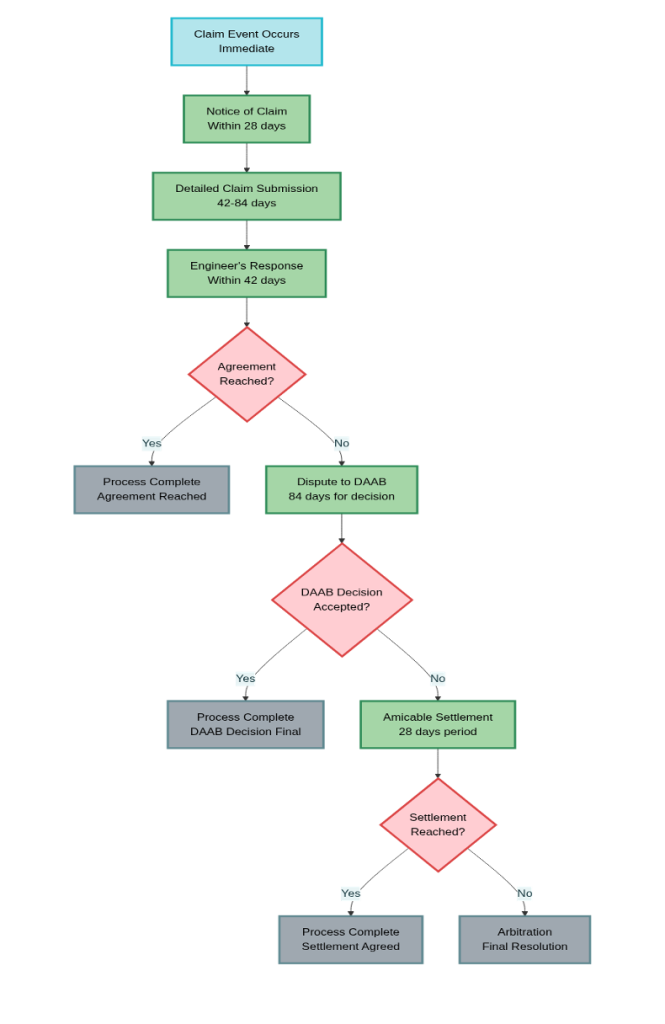
FIDIC Claims Management Process Flowchart – A comprehensive guide showing the step-by-step procedure for managing claims under FIDIC contracts, including critical timeframes and decision points.
3. The Engineer’s Role and Determination
The Engineer acts as a central figure in this process, evaluating claims impartially. Under the 2017 contracts, the Engineer’s role is enhanced by the requirement to act “neutrally” when making a determination. The Engineer must assess the evidence, consult with both parties, and issue a fair determination within 42 days of receiving your detailed submission.
Strategic Claims & Documentation
Not all claims are created equal. Some categories, such as those for variations or delayed payments, often have a clear contractual basis and a high success rate. Others, like disruption or force majeure claims, are more complex and require detailed analysis and evidence.
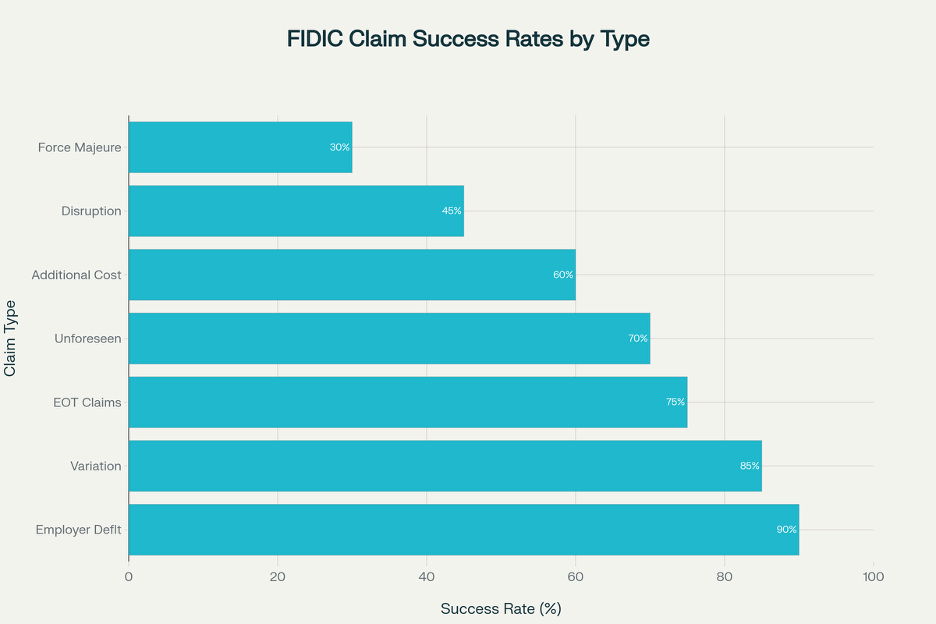
FIDIC Claims Success Rates by Type – Analysis of claim success rates across different categories, providing insights for project managers on which claims have the highest probability of success.
Regardless of the type, robust documentation is the key to success. You should maintain contemporary records—documents created as events happen, not retrospectively. Digital tools and contract management software can be game-changers, providing time-stamped, tamper-evident records that strengthen your position and ensure you don’t miss a single deadline.
From Disputes to Collaboration: The DAAB
The 2017 FIDIC editions introduced a major innovation: the Dispute Avoidance/Adjudication Board (DAAB). Unlike traditional dispute boards that only get involved after a dispute has arisen, a DAAB is a standing body that stays engaged with the project from start to finish. This continuous involvement allows the DAAB to identify and resolve issues before they escalate into formal claims, promoting a collaborative, problem-solving approach. This proactive system is a testament to the industry’s shift toward dispute avoidance.
Conclusion: A Competitive Edge
Effective claims management isn’t a reactive administrative task; it’s a proactive strategy that transforms potential project obstacles into manageable business processes. By understanding contractual procedures, maintaining meticulous documentation, and embracing new technologies, you can not only protect your project but also gain a significant competitive advantage. The future of FIDIC contracts is about leveraging technology and collaboration to ensure projects are not just successful but also efficient and harmonious.
Mastering these elements is what truly separates successful organizations from those just trying to survive in a competitive market. At our core, we believe that turning a project’s biggest challenges into opportunities requires a balanced approach—one that bridges contractual requirements with on-the-ground realities. Our team’s years of experience and deep industry knowledge are dedicated to helping you take the most accurate steps.
We are committed to helping clients achieve long-term, sustainable impact on their projects. We aim to be a partner who supports you at every stage, ensuring you have the expertise needed to navigate complexities and find proactive solutions. This is how we bring harmony to the built environment.
References
- A conscientious approach to claims management strategies. Bogazici University Digital Archive. https://digitalarchive.library.bogazici.edu.tr/bitstreams/42d03cc6-0034-4b3d-9e1e-2dfee4038e7b/download
- The Management of Contract Claims and the Resolution. FIDIC. https://fidic.org/sites/default/files/ECV_CCM_FIDIC_Module_2_Vienna_October.pdf
- Claims and Management under FIDIC Standards. KE Leaders. https://keleaders.com/claims-and-management-under-fidic-standards/
- Sub-Clause 20.1 – the FIDIC Time Bar under Common and Civil Law. Fenwick Elliott. https://www.fenwickelliott.com/sites/default/files/jg_sub-clause_20.1_-_the_fidic_time_bar_under_common_and_civil_law.pdf
- Effective FIDIC Contract Administration: A Guide. Quantity Surveying Coach. https://quantitysurveyingcoach.com/contract-administration/effective-fidic-contract-administration/
- FIDIC contracts in the Middle East. AFITAC. https://afitac.com/2020/06/16/fidic-contracts-in-the-middle-east/
- The new FIDIC provision for a Dispute Adjudication Board. FIDIC. https://fidic.org/sites/default/files/34%20The%20new%20FIDIC%20provision%20for%20a%20Dispute%20Adjudication%20Board.pdf
- The role of technology in construction contracting: 7 tools. PlanRadar. https://www.planradar.com/au/technology-construction-contracting-tools-and-trends-2024/
- Contract Management, Claims and Disputes under the FIDIC Red Book. Diales. https://www.diales.com/news/contract-management-under-the-fidic-red-book
- FIDIC 2017: Clause 20 – Employer’s and Contractor’s Claims. International Construction Knowledge Hub. https://internationalconstructionknowledgehub.com/wp-content/uploads/GMC-FIDIC-2017-Clause-20-Employers-and-Contractors-Claims.pdf